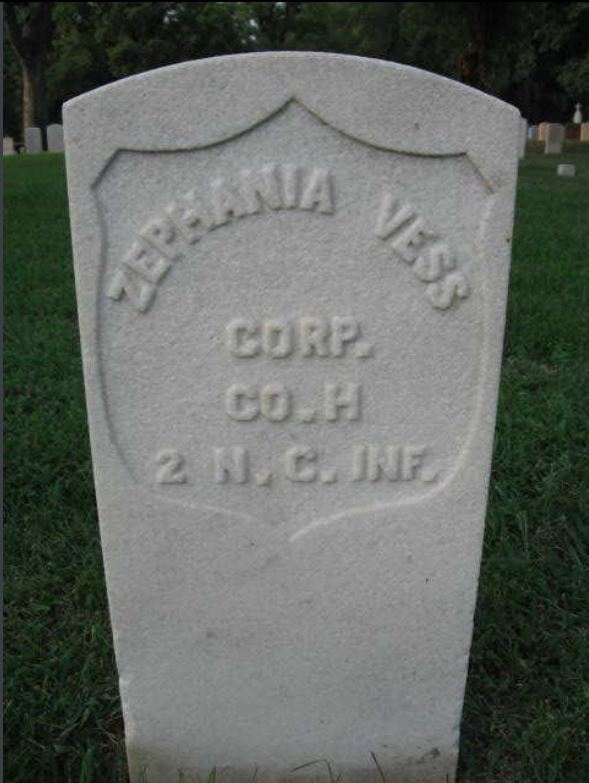
Zephaniah Vess was born in 1842 on Cedar Creek in Rutherford County, North Carolina. He was the sixth son of Peter Vess and Catherine Crook, named after his uncle, Zephaniah Crook of Buncombe County. He had a fair complexion, with blue eyes, and light-colored hair.
Life with his parents was short. His father, Peter, died between 1846 and 1850 after the family lost their farm, and his mother, Catherine, passed away shortly thereafter in 1852. Following his mother’s death, his younger siblings went to live with Dempsey Sumner, a close family friend who lived between the Crook and Souther families in Fairview, Buncombe County.
It is uncertain, if Zephaniah joined them, as records have been lost; but it was also common for close family and friends to take in orphans informally without having to involve the court.
In 1860, while his siblings were in Buncombe County, 18-year-old Zephaniah was living with N.H.P. Whiteside (Noah Patterson Whiteside), a young local landowner in Rutherford County. He was likely hired to help on the farm, as later records state he was a farmer by occupation.
The 1860 Court Case: A Neighborhood Feud
In 1860, Zephaniah Vess and Isaac Bradley found themselves sued by George Nix for “trespass with force and arms” alongside a staggering $2,000 in damages.
A sheriff’s warrant was issued to round up a massive list of defendants from the Buffalo Creek area, including members of the Whiteside, Ledbetter, and Bradley families. Highlighting the tight-knit nature of the community, N.H.P. Whiteside stepped up to post a massive $4,000 appearance bond to ensure Zephaniah Vess and Isaac Bradley made it to court.
Unfortunately, court records detailing the cause and outcome of the dispute appear to be lost, but the records we do have apparently suggest a fierce local neighborhood clash.
Civil War: Changing Sides
When the Civil War erupted, Zephaniah enlisted in 1862 on the Confederate side, likely pressured by the military service of his older brothers and the strong military legacy of the Whiteside family.
However, life as a Confederate soldier was harsh, and like many men from Western North Carolina, Zephaniah soon deserted. By 1863, he made his way to Tennessee and enlisted in the Union Army (joining the Mounted Infantry). Union enlistment offered better conditions, regular pay, and vital legal protection from being executed as a Confederate deserter.
Proving himself a capable soldier, Zephaniah was promoted to Corporal in 1864. He served faithfully for three years, but tragedy struck just as the war was coming to a close. Zephaniah, age 22, died on April 4, 1865, at the Asylum Hospital in Knoxville, Tennessee, from typhoid pneumonia—just weeks before the peace he had fought so hard to reach.
We know that Peter Vess lost his land to the Souther family in 1846 to cover a $50 debt; however, this particular record between Vess and Souther, reveals so much more…
Court Debt
This record between Vess and Souther is a “Deed Trust to Indemnify a Surety.” A landowner (Vess) puts up their property (Cedar Creek) as collateral to protect someone (Souther) who agreed to act as their financial guarantor for a legal obligation or court debt. This means the court would hold Souther liable if Peter defaulted on his court fees.
This record tells us that there was a suit between Peter Vess and the William Young estate. The specifics of their case appear to be lost to time, but whatever the case was, it was worth risking his entire property.
This record also reveals just how deeply the Vess and Souther families were connected, as such contracts were rarely, if ever, between strangers. These types of contracts were almost always made between relatives or deeply connected family allies. Thus, making their mysterious relationship to each other even more curious.
Peter Vess was allowed to remain on the property, so long as he did not default with the court.
Peter likely defaulted with the court, due to his death; as he is not listed with Catherine and the children on the next census in 1850, and they were no longer residing on Peter’s property on Cedar Creek in Broad River (they relocated to the Bill’s Creek community).
Due to his death, the court would have found Peter Vess in default. This would make Joseph Souther liable for the payment to the court.
To avoid having to pay out of his own pocket, Souther had no other choice but to evict Catherine and her children from the property to sell it. Unfortunately, he couldn’t sell the property while Catherine was still living.
Catherine didn’t sign over her dower rights in the 1846 Deed to Joseph Souther, preventing Souther from ever owning the land outright. At the time of Peter’s death, Catherine lost her right to live on the property due to the 1846 deed to indemnify a surety, but through her dower rights, she still claimed a portion of the value of the land; therefore the property could not be sold until after her death in 1852.
Displacement
In 1850, we see Catherine and the children listed on census next to her oldest son, John Vess, who probably provided for his mother and siblings financially after Peter’s death.
John was probably a tenant farmer for the Conner/Crawford families, as we see them listed nearby with land. Peter and Catherine’s son, Andrew Logan Vess will later marry Cynthia Conner in 1867.
In 1852, Catherine’s estate (the value she still held claim to), on Cedar Creek, was sold to another family, clearing up whatever debts were owed to Joseph Souther and the court .
A guardian ad litem was appointed for the minor children to represent their share in the estate and notices went out to the adult children who were non- residents of Rutherford County, North Carolina. After all the debts were paid, the children would receive whatever was left (if anything).
It appears the minor children were bonded out to a close family friend, Dempsey Sumner, who lived in between the Crook and Souther families in Fairview, Buncombe County, NC. We see them on the 1860 census together; except for Zephaniah Vess, who lived with the Whiteside family in Rutherford County, NC.
Dempsey Sumner likely had a family connection with the Vess family. He obtained custody of them as a single man, which was rare, if not family. The children also stayed with him long past the ages of a normal legal indentured contract, further suggesting a family connection. He also lived out the rest of his life, childless, on his property, even after he sold it to Jasper Vess, the youngest son of Peter and Catherine Vess.
Strategic Separation: Economic Survival
John Vess disappears somewhere out of state after 1850, leaving his wife and children behind in North Carolina.
He likely traveled out of state to find work, as many often did during poverty. I believe I may have found him in Greenville South Carolina, in 1857, working for the Tyger River and Mush Creek Ditch Company. This company offered housing for their workers, which is probably why we do not see him on the 1860 census.
In 1854, the divorce between John and Elizabeth Vess was posted in the newspaper; on the very same day, Elizabeth married Joshua Souther. This strongly suggests that John’s divorce in 1854, was mutually planned to ensure his wife and children were financially secure. Generally, there would have been a period of courtship between divorce and a new marriage.
Without the family farm, John Vess also faced poverty. After his mother’s death, the minor children were re-homed with close family in Buncombe (Dempsey Sumner), leaving his own family without financial security. Allowing his wife to divorce and remarry, would be the best option for his family to survive economically and the only way a woman could divorce, was if her husband deserted /abandoned her. Thus, John moved out of state.
Having married into the same family that took away the family farm in the first place, and married on the same day as divorce was announced, may look like betrayal, but at that time, it was economic survival.
John’s children had better opportunities with the Souther family, and thus they did, as his children were bond out to Joshua Souther in 1855, promising clothes, housing, food, a trade apprenticeship, and an education.
This was economic survival, mutually planned and executed between close family allies. The question still remains – how and why, were the Souther families deeply connected to the Vess family?
Originally Published September 27, 2021 • Updated February 24, 2024• Updated August 26, 2026
As you may know, I have been investigating a family story about an “outlaw” that the Vess family was supposedly involved with at one time. Thus far, I’ve explored possible connections with the outlaw, Lewis Redmond, who was “loved and respected” by the residents of the Dark Corners of South Carolina; however, there is no evidence of a direct connection with the Vess family. I’ve also explored a genetic allied-family connection with John “Redhead” Hodge; yet, there is no evidence suggesting he was an outlaw.
Perhaps, the Vess family has nothing to do with an outlaw (or particularly one with “red hair”), or perhaps I’ve been looking in the wrong place…
I’ve been exploring a series of newspaper articles (1835) that frequently mentioned the name “Vess.” The articles appear to be a continuing narrative of true events; however, without starting with the very first article, it is very difficult to tell who this “Vess” person is, in which, these articles are talking about; so I began to dig around…
John Andrew Murrell- The Great Western Land Pirate
After much research, I discovered that these newspaper articles are about the notorious outlaw, John Andrew Murrell.
John Andrew Murrell, according to family history sites, is strongly believed to have been just a horse thief whose notorious reputation as a legendary dangerous outlaw was the result of fabricated stories by Virgil A. Stewart and others.
In Stewart’s narrative, he often mentions his experiences dealing with Matthew Clanton and William Vess; in which he accuses them of damaging his reputation. In one article, he tells a story on how the Vess family tried to poison him and take his land.
Virgil A. Stewart came to the Choctaw Purchase (today known as Grenada County, Mississippi) for prospects of land. According to H.R. Howard, Virgil was employed by Matthew Clanton, who owned a store, and was recommended to board with the Vess family, who were close friends of Matthew Clanton. The publication implies that Mathew Clanton and William Vess were “associates” of John Andrew Murrell.
Later, by a petition of neighbors, Mathew Clanton’s side of the story was published, refuting the accusations against him and the Vess family that Stewart wrote about in his narrative. According to numerous websites, historians believe Virgil A. Stewart’s narrative was “overly-exagerated” and “fictitious.”
William Vess – Disappeared Into the Swamp
Genealogical records confirm that both William Vess and Matthew Clanton were real people. There are land records for Matthew Clanton and William Vess (wife Ann) between 1835-1840 in Mississippi.
According to Holcomb.org, the area in which the above events took place, known as Tuscahoma (Choctaw Purchase), no longer exists. Therefore, any early records pertaining to the residents living in the areas that was once part of the Choctaw Purchase are likely scattered among several different counties (Grenada, Yalobusha, Tallahatchie, etc).
William Vess can be found on the 1840 census record in Yalobusha, Mississippi, showing just him and his wife, Ann. In 1850, in Tallahatchie, Mississippi, Ann Vess is shown living with a young Martha A. Worsley (age 11), but no William Vess.
In the 1850 Probate records for Tallahatchie, Mississippi, Ann “Vest” petitioned for and was granted letters of administration, allowing her to settle her husband’s estate (William R. “Vest”), who did not have a will.
She explains that her husband disappeared in September of 1849. He left without telling her where he was going. She heard from him 10 days later, that he was in the “swamp west,” and hadn’t heard from him since. She believes he may have “perished in the swamp.”
It appears that William and Ann Vess didn’t have any children, and she sought to protect her right to keep his land.
But, what is this “swamp west” Ann mentioned in the probate record?
In 1849, Congress passed the Swamp Land Act, where local governments can sell land in the swamp areas. At this time, it only applied to Louisiana, however, Mississippi residents ventured off into the western Mississippi Delta swamps early, anticipating that the Swamp Land Act would expand to Mississippi.
William Vess most likely set out to the swamps to make an early claim on land; which he probably didn’t tell anyone about, as it wasn’t legal yet.
However, the western Mississippi Delta swamps were notoriously dangerous, with floods, disease, and outlaws. A lot of prospectors died venturing off into the swamps.
Because he has a recent past tangled up with the John A. Murrell conspiracy, one can’t help but wonder, if he had intentionally disappeared into the swamp (as some often did) to start a new life, or meet up with the remaining “land pirates” who hid there.
We’ll likely never know.
William R. Vess – Connection To Pryor and William Vess
I am curious though, if William R. Vess could also be or related to Pryor and William Vess in White County, Tennessee. Only because it sounds like a Pryor and William Vess kind of adventure…
Pyror and William Vess are documented trouble makers, from Virginia all the way down into Tennessee. Interestingly, William Vess disappears from record after Pryor Vess died in jail in 1831 (Warren County, TN). AND, William R. Vess, doesn’t appear in Mississippi until 1835. Hmmmm.
Also, there is a young William R. Vess living with the Dodson family in 1850 (not sure who he belongs to); could he be related to William R. Vess in Mississippi??
I wonder if William R. Vess in Mississippi could be related to our R1a2 Vess family. I mean, the story must of come from somewhere, right?
According to FindAGrave.com, it mentions John A. Murrell having “curling auburn hair,” and he was an outlaw, an outlaw that had “followers,” rather than actual “gangs,” and he was named in a conspiracy involving a “Vess.”
Maybe it’s just a coincidence or perhaps, this widespread publication influenced a Vess family story about a red-headed outlaw the Vess family followed and adored. It certainly makes one wonder…
When I see “Andy Vest” in a North Carolina record, I immediately think of Andrew Logan Vess, but turns out, this is not Andrew Logan Vess at all. This is another unknown VESS!!
I found this record a while ago, for Benjamin and Andy Vest. It comes from the Polk County, North Carolina Court Records, dated 1856. They were ordered to be brought to court to be “dealt with,” no further details were provided.
I was left wondering who in the world is Benjamin (assuming Andy was Andrew Logan Vess), and what in the world did they do!
Turns out, Benjamin and Andy (Andrew) Vess are young teenagers, born between 1846/1847 in North Carolina. They appear to have the Vess surname, with records alternating between Vess and Vest in court-records. Interestingly, later records show that Benjamin settled with the VEST surname, while Andrew appears to have settled with the VESS surname.
1856 Court Records
In March of 1856, they were ordered to be brought to court to be dealt with; assuming they might be orphans.
In June of 1856, they were separated, with the courts ordering the Sheriff to take Benjamin Vest to Jonathan Arledge and Andy Vest to Thomas Littlejohn.
In September of 1856, Benjamin “Vess” entered into an apprenticeship under Jonathan Arledge until the age of 21.
In December of 1856, Andrew “Vess” entered into an apprenticeship under Thomas Littlejohn until the age of 21.
Records indicate that Benjamin “Vest” married Harriet Davidson in 1872 and Andrew “Vess” married a woman named Liewanner in 1899.
Where Did They Come From?
I do not know who the parents of Benjamin and William Vess are or where these kids even came from, but their Polk County court record references Henderson County. Polk County was formed in 1855 from parts of Henderson and Rutherford County.
I am only aware of one VESS family associated with Henderson County, NC. Elizabeth Vess, (ex-wife of John Vess) married Joshua Souther in Henderson County, North Carolina in 1856, but later records show them as residents of Buncombe County. Joshua Souther adopted Elizabeth’s youngest children, so I do not know where Benjamin and William would even fit in.
There must be another Vess/Vest family in the area that we aren’t aware of yet.
I am always saying it! Just when I think there is nothing more to discover, I end up stumbling across something new!
This record is great, as it further supports a Vess-Crook connection.
In 2023, it was discovered, via genetic genealogy methods, that the maiden name of Peter’s wife, Catherine, is CROOK, instead of Cook. An incredible discovery that has opened the door to potential discoveries of Peter and Catherine’s earlier lives and family history.
Catherine Crook is the daughter of John E. Crook and Rachel Haynes of Rutherford County, North Carolina, with the Crook family also having ties to Buncombe County, North Carolina.
During the early 1800’s, John E. Crook, obtained land in Rutherford County, North Carolina, joining his in-laws property (Haynes) on Cove Creek near Broad River, close to Bill’s Creek Baptist Church.
In 1830, Zephaniah Crook, (son of John E. Crook, Catherine’s brother) obtained land joining his father’s land in Buncombe County, North Carolina (on the Swannanoa River), with the land record indicating that John E. Crook is deceased. I haven’t found any records as to what happened to his land; maybe it eventually transferred to Zephaniah.
In 1831, Peter Vess obtains land on Cedar Creek in Rutherford County, North Carolina (later to become Buncombe County). Although Peter lived in Rutherford County, NC, he appears to have a connection to Burke County, North Carolina (later McDowell County), with his children having connections to both Burke and Buncombe County, suggesting possible early family ties to both counties.
Some of the earlier families of Burke County, NC eventually settled in the same general area as the Crook family, in Buncombe County (including the Souther family). There is a family relationship between Peter and these earlier families, but those specific relationships have yet to reveal itself. We also find Peter’s youngest children in Buncombe County, after Catherine’s death.
In 1835, Zephaniah Crook sells his property on Swannanoa River to Frederick Burnett. Peter Vess is listed as a witness. I had to do a double take, because the document is titled, Buncombe Deeds 1890, yet, the land record itself, is specifically dated 1835, not 1890. This isn’t entirely surprising, as I’ve uncovered records from much weirder places.
By researching Catherine’s family, we might be able to find clues to Peter’s past, as I would think they would have met through mutual families.
I was able to dig up another record for Jonathan Vess in Lincoln County, Missouri.
This is exceptionally rare! I was not expecting to find any more records in Missouri, as records prior to 1830 in Missouri are extremely limited!
I found him, out of chance, in the Lincoln County, Missouri Probate Records. The date appears to be 1826, listed in a guardianship record for William Quinn, who was appointed guardian of Isiah Gilmore. William Quinn was ordered to pay bond to 3 men, Jonathan Vess, John “Hepperson,” and Chirstopher McVay, as securities.
In short, these men, usually close neighbors or family members, will be responsible for paying the bond with their own money, in the event, William Quinn were to mismanaged the funds for Isiah Gilmore. It’s my understanding, that this is kind of like an insurance policy for a child who inherited cash/property.
Unfortunately, none of these records seem to provide us any clues as to where Jonathan Vess was prior to 1825; which means, we’ve likely hit another brick wall!
However, it does appear that Christopher McVay and Jonathan Vess in the probate record with William Quinn might have been neighbors.
In 1825, Jonathan Vess obtained land from Alfred Gordon, whose property joined Benjamin Allen’s line. On the 1830 census (the first available census for Lincoln County, Missouri), shows Christopher McVay, listed next to Benjamin Allen, and John Quinn (possible relative of William Quinn). Had Jonathan Vess remained in Missouri after 1829, he probably would be listed on census in between Benjamin Allen and Christopher McVay.
While this strongly suggests he is neighbors with those listed on the probate record, it doesn’t mean they couldn’t be related to them either. Families often traveled in groups, and reside next to each other (or really close to each other). He could have a sister or older daughter, who might be married to one of his neighbors. Or, one of these neighbors could be a cousin.
We just don’t have enough information, to determine whether Jonathan Vess is a lone wolf in Missouri, or if he is following family.
Interestingly, I have been reviewing the Stephen F. Austin Registry of Families to see who else might have arrived in Texas the same time as Jonathan Vess in 1829 and so, far, I have found a John Brown, with his wife Nancy, who not only arrived in Texas in 1829, but also did their oath around the same time in December. Furthermore, I discovered a land record in Jackson County, Texas dated 1830 for a John Brown. I am curious, if this is the same John Brown from Missouri, and if so, what part of Missouri did Mr. Brown come from?
Of course, more research needs to go into this, but it’s the only lead I have for right now.
It’s always exciting to add newly discovered ancestors to the Vess family tree!
Rachel Melinda Vess (1881-1969) is a new addition to the Peter Vess lineage. She is the daughter of James Harvey Vess and Mary Josephine Dalton, granddaughter of Andrew Logan Vess and Lucy Malinda Halford, and great-granddaughter of Peter Vess and Catherine Crook.
Rachel M. Vess never appeared on census, due to the 20 year gap in missing census records between 1880 – 1900. Imagine how many Vess ancestors are missing due to the lost 1890 census!
Rachel Vess married Henry O. Smith on May 11, 1899 in McDowell County, North Carolina. Together they had 5 children: Ella Mae, Lina, Alan, Nelson Burlan, and Bulah Josephine.
From what we can tell, the names “Rachel” and “Melinda” hold significant importance to the Peter Vess family, as we see these names repeated throughout several earlier generations. We do know that Rachel is the name of Catherine Crook’s mother, Rachel Haynes. We also know that Peter and Catherine had a daughter named Rachel. However, I am not sure where the name Melinda comes from – perhaps Peter’s side of the family? Records tell us that one of Peter and Catherine’s daughters also went by the name Melinda.
Josiah (Joseph) Vess is the son of Peter Vess and Catherine Crook in Rutherford County, North Carolina. Not much is known about him, as he seems to have disappeared after 1850, like his older brother John. Fortunately, I was able to dig up a little something…
Burke County
Josiah Vess was born in Rutherford County, North Carolina, in 1822, most likely on Knobs Creek. In 1831, his father obtained land on Cedar Creek (located in the Broad River Township), which is sandwiched in between Burke and Buncombe County.
We know from Peter’s records, that the family had connections to Burke County, even though they were residents of Rutherford County. This was likely because Cedar Creek is located closely to the Burke County border.
His parents, Peter and Catherine, left Bill’s Creek Baptist Church prior to 1836, and by 1838, they appear to have become members of Bethlehem Baptist Church, located in Crooked Creek of Burke County. This area of Burke County, will later become part of McDowell County in 1842.
Bastardy Bond: Elizabeth Justice
In 1844, Josiah Vess of Rutherford County, was called to McDowell County, to answer to a Bastardy Bond via Elizabeth Jutis (Justice).
I could not find any more court records about it, so I cannot confirmed whether or not Josiah Vess had a child with Elizabeth Justice. But, if true, the child may have been William A. Justice.
William A. Justice was born in 1844 in McDowell County, and died during the Civil War from disease. The 1850 census reveals his mother’s name was Elizabeth Justice, and there was no father listed on census with her.
1846: Family’s Return To Bill’s Creek
On April 27, 1846, Josiah married Zillah (Zilia) Early, daughter of Andrew Early and Nancy Duncan. Together they had six children: Mary Jane, William Bailey, Rhoda Adeline, Zilla, John Jefferson (pictured below), and Emmaline.
Josiah’s son, John Jefferson Vess and wife, Dorce Sylvain Laughter, with children, Jason and baby Zilla.
During the Fall Court of 1846, Josiah, and his older brother John, are part of the deed transaction between his father, Peter Vess, and Joseph Souther. This is when Peter gave his land (on Cedar Creek) to Joseph Souther to settle a $50 debt.
On December 26, 1846, Josiah and his wife, Zilla, along with his brothers John, Andrew, Alfred, and Alexander, become members of Bill’s Creek Baptist Church, joining their mother, Catherine who returned in 1844.
On the 1850 census, the Vess family is back in Bill’s Creek (Rutherford Co).
Here we see Josiah, listed with his wife, Zilla, and two of their children, Mary and William. His older brother, John and his family are also listed, as well as their mother Catherine, with the rest of his siblings (except for Andrew, who is living near his Halford in-laws).
Peter probably died shortly after transferring his land to Joseph Souther in 1846.
1849-1853 Conflict With Father-In-Law
We can find records of Josiah Vess in the book, “Bill’s Creek Baptist Church: Two Hundred Year History,” by Helen M. Lu.
Lu notes that Josiah Vess was a member of the church in 1846, 1847, 1848, and 1849.
On October 15, 1853, he was excluded due to excessive drinking. In November, he was charged for threatening to kill his father-in-law (Andrew Early). However, his membership was restored in December, after admitting that he did make “some threat,” but did not follow through with it.
Death of Josiah and Zilla Vess
There is no official record of Josiah’s death, however, Josiah and his family seem to have disappeared after the 1850 census, with their children reappearing after 1870 as adults.
We do know that Zillah died on December 26, 1862, as we find her memorial in the book, “Bill’s Creek Baptist Church: Two Hundred Year History,” by Helen M. Lu. Her memorial does not mention her husband, focusing largely on her young children, suggesting he may have passed away prior to 1860.
“Sister Vess left behind a numerous family of helpless little children to mourn their irreparable loss.” – Bill’s Creek Baptist Church: Two Hundred Year History, by Helen M. Lu.
1860: The Nanney Family
Although Zilla’s death is reported to be in 1862, her children appear to be living with the Nanney family on Cathey’s Creek in 1860.
On the 1860 census, in Cathey’s Creek, Rutherford County, North Carolina, Amos and Temp Nanney list their children as “Thomas, Mary, Zeruah, Jothan, William, and Infant.”
Thomas is the son of Amos Nanney, as later records reveal; but, the other listed children, do not appear in future records or are listed on any family trees. However, their names do match the names of Josiah’s children (Mary, Zillah, John, and William), strongly suggesting, these children are likely VESS.
I cannot confirm 100%, that the children of Josiah were living with a Nanney family in 1860, as the record itself is badly faded (below is just a transcription of it); however, there are a couple of other Nanney-Vess connections.
Nanney Family Connections
Josiah’s oldest daughter, Mary, married Charles Nanney, son of Randal Nanney. And, his son, John Vess is listed in the will for Tinsey Searcy (Nanney), daughter of James Nanney (Amos Nanney’s uncle).
I wasn’t able to find any earlier Vess-Nanney connections. They do not appear as members of Bill’s Creek Baptist Church, so I am not sure how the children of Josiah and Zilla became acquainted with the Nanney family.
Burke County, North Carolina is interesting, because many families in Wilkes County, North Carolina relocated to this area after 1800, including our families of DNA interest: the Rose, Parks, and Sparks families. But, so did the Souther family, who were once close neighbors of Absalom Vess in Wilkes County, North Carolina.
Peter Vess seems to have a connection with some of the Wilkes County, NC families in Burke County, NC, but whatever those connections are specifically, have yet to reveal itself…
I found a new Burke County record, dated 1833, with Peter Vess listed on the “Sale of the Estate of Moses Noblitt/ Noblett,” having obtained an ax and a saw from the sale. Also listed, but not the least surprising, is also John Souther. Another record with Vess and Souther.
You can find Noblitt/Noblett on the Vess Family tree, but the connection is generations later, via sisters, Lola Mae Vess and Mattie Vess, daughters of Alfred Vess and Nancy Banther (descendants of Andrew Logan Vess). They married Noblitt cousins, related to the earlier Noblitt family of Burke County, NC.
Moses Noblitt lived on Crooked Creek. In 1831, he added 5 acres to his existing property next to the Davis family. This is interesting for several reasons:
The Vess and Davis families have a long oral history of being old close families, but no one seems to know their history together. We don’t have a lot of Davis-Vess connections on the family tree. Yet, Andrew Logan Vess is buried in the Davistown Free-Will Baptist Church cemetery, that used to be a private cemetery for the Davis family.
Michael Souther, from Wilkes County, North Carolina obtained land in 1801 on Crooked Creek. This makes me wonder if Peter Vess could have also been on Crooked Creek prior to 1820.
Other interesting families on Crooked Creek include the Burgin, Bird, Bellew, and Crawford families:
a) Burgin and Bird are some of my earlier ancestors via my 2nd great grandmother, Cora Nevada Moffitt, wife of Pinkney Vess (son of Andrew Logan Vess).
b) The Burgin family was a prominent family in North Carolina, with large tracts of land and plantations, who were also involved in politics. A website during the early 2000’s, mentioned Burgin having a “Vess” servant, which has been long since deleted (I never saved a copy). If not a man named “Vess,” I do not know what a “Vess” servant could mean. But the idea of Peter having been an indentured servant is not new.
c) Jesse Souther, brother of Michael Souther, came to Burke County after 1810 and appears on record near the Burgin, Bird, and Bellew families.
d) Bellew interests me, because we don’t exactly know (100% for sure) the origins of Nathaniel Vess and Clarinda Bellew.
e) Crawford interests me, because I share DNA matches with Willis Vess of Franklin County, Alabama via a Crawford connection – which is bizarre, as the Willis Vess family, to the best of my knowledge, has never been to Burke, Rutherford, or Buncombe County.
Peter Vess obtained land on Cedar Creek in Rutherford County, North Carolina in 1831. This property is located in the Broad River Township, which is sandwiched in between Buncombe and Burke County. Peter’s property is close to the Crooked Creek area, where we are finding records of him in Burke County.
There is so much more to explore in Burke County, North Carolina; especially, in the Crooked Creek area (now McDowell Co), as many of those families later relocated to Buncombe County, where we have more Vess connections.
I didn’t think there were anymore records to be discovered for Nathaniel Vess.
When it comes to early Vess ancestors, Nathaniel Vess probably has the most records, so it was extremely exciting when I was able to find more records for him.
1849 Buncombe County, North Carolina: Land Record
In 1849, Jackson Vest (Andrew Jackson Vess), son of Nathaniel Vess, makes several transactions with D. E. Freeman, to secure a debt, which requires repayment. A. Baird is authorized to auction Jackson’s property, if repayment is not made. Nathaniel Vess is witness to the transactions.
Jackson transferred the Deed of Trust to D. E. Freeman on 11/3/1849.
1853 Haywood County, North Carolina: Court Record
In 1853, State Vs Nathan Vest, Nathaniel Vess had a judgement against him for $100, which was dischargeable upon payment to the court.
1854 Haywood County, North Carolina: Court Record
In 1854, Nathaniel Vess was called upon as a witness in a court case between Robert Rogers (and others) and John L. Smith (and others).
The case pertained to the estate of Lewis Smith (deceased 1842), specifically, regarding a dispute about a rental agreement and maintenance responsibilities of the property that were not being kept up.
Robert Rogers requested that rent be minimal due to the conditions of the property affecting the land value. There were several witnesses giving testimony about the condition of the property and improvements (if any).
Nathaniel Vess was a witness for John L. Lewis, giving testimony about the condition of the property the past 3 years and noting changes to the property.
He submitted a request for reimbursement for $1.40, for appearing as a witness and for travel expenses.
1856 Haywood County, North Carolina: Court Record
In 1856, Nathaniel Vess was bound to $500 to the court for the welfare of a child Abraham Vess, had out of wedlock with Caroline Mathis.
1860 Haywood County, North Carolina: Land Record
In 1860, there are 2 land records (2857 & 2858) for Nathaniel Vess.
He first claimed 100 acres located on Hurricane Creek & waters of Pigeon River.
Then, he claimed 100 acres on the east side of Pigeon River with John L. Smith.
Nathaniel Vess of North Carolina
I never thought in a zillion years, I’d ever discover a land record for Nathaniel Vess, let alone court records.
When we think of Nathaniel Vess, we immediately connect him to South Carolina; however, he appears to have spent a good portion of his adult life in North Carolina. It’s also important to note, that almost all of his children were married in Haywood County, North Carolina.
But, remarkably, not a single record suggesting any kind of connection to Peter Vess of Rutherford County, North Carolina, despite being in Rutherford County, North Carolina in 1830 with his Bellew in-laws. And, nothing to further support his connection to South Carolina.