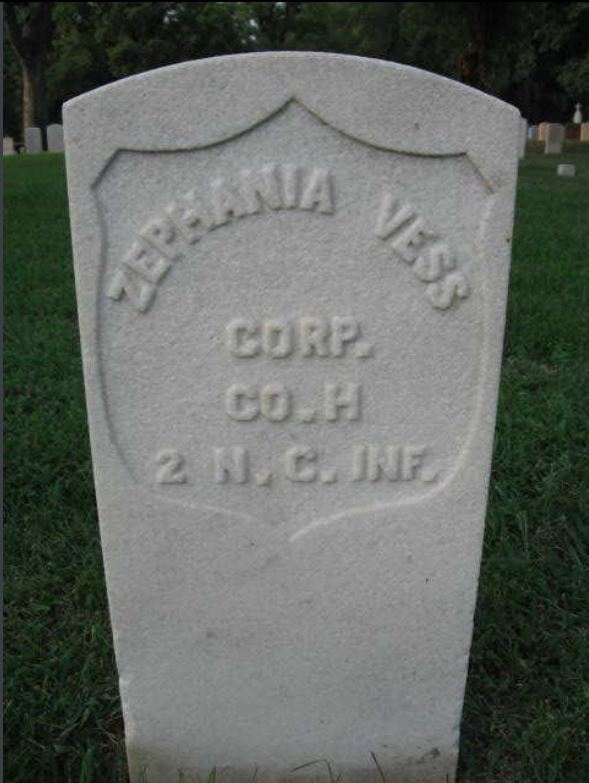
Zephaniah Vess was born in 1842 on Cedar Creek in Rutherford County, North Carolina. He was the sixth son of Peter Vess and Catherine Crook, named after his uncle, Zephaniah Crook of Buncombe County. He had a fair complexion, with blue eyes, and light-colored hair.
Life with his parents was short. His father, Peter, died between 1846 and 1850 after the family lost their farm, and his mother, Catherine, passed away shortly thereafter in 1852. Following his mother’s death, his younger siblings went to live with Dempsey Sumner, a close family friend who lived between the Crook and Souther families in Fairview, Buncombe County.
It is uncertain, if Zephaniah joined them, as records have been lost; but it was also common for close family and friends to take in orphans informally without having to involve the court.
In 1860, while his siblings were in Buncombe County, 18-year-old Zephaniah was living with N.H.P. Whiteside (Noah Patterson Whiteside), a young local landowner in Rutherford County. He was likely hired to help on the farm, as later records state he was a farmer by occupation.
The 1860 Court Case: A Neighborhood Feud
In 1860, Zephaniah Vess and Isaac Bradley found themselves sued by George Nix for “trespass with force and arms” alongside a staggering $2,000 in damages.
A sheriff’s warrant was issued to round up a massive list of defendants from the Buffalo Creek area, including members of the Whiteside, Ledbetter, and Bradley families. Highlighting the tight-knit nature of the community, N.H.P. Whiteside stepped up to post a massive $4,000 appearance bond to ensure Zephaniah Vess and Isaac Bradley made it to court.
Unfortunately, court records detailing the cause and outcome of the dispute appear to be lost, but the records we do have apparently suggest a fierce local neighborhood clash.
Civil War: Changing Sides
When the Civil War erupted, Zephaniah enlisted in 1862 on the Confederate side, likely pressured by the military service of his older brothers and the strong military legacy of the Whiteside family.
However, life as a Confederate soldier was harsh, and like many men from Western North Carolina, Zephaniah soon deserted. By 1863, he made his way to Tennessee and enlisted in the Union Army (joining the Mounted Infantry). Union enlistment offered better conditions, regular pay, and vital legal protection from being executed as a Confederate deserter.
Proving himself a capable soldier, Zephaniah was promoted to Corporal in 1864. He served faithfully for three years, but tragedy struck just as the war was coming to a close. Zephaniah, age 22, died on April 4, 1865, at the Asylum Hospital in Knoxville, Tennessee, from typhoid pneumonia—just weeks before the peace he had fought so hard to reach.
We know that Peter Vess lost his land to the Souther family in 1846 to cover a $50 debt; however, this particular record between Vess and Souther, reveals so much more…
Court Debt
This record between Vess and Souther is a “Deed Trust to Indemnify a Surety.” A landowner (Vess) puts up their property (Cedar Creek) as collateral to protect someone (Souther) who agreed to act as their financial guarantor for a legal obligation or court debt. This means the court would hold Souther liable if Peter defaulted on his court fees.
This record tells us that there was a suit between Peter Vess and the William Young estate. The specifics of their case appear to be lost to time, but whatever the case was, it was worth risking his entire property.
This record also reveals just how deeply the Vess and Souther families were connected, as such contracts were rarely, if ever, between strangers. These types of contracts were almost always made between relatives or deeply connected family allies. Thus, making their mysterious relationship to each other even more curious.
Peter Vess was allowed to remain on the property, so long as he did not default with the court.
Peter likely defaulted with the court, due to his death; as he is not listed with Catherine and the children on the next census in 1850, and they were no longer residing on Peter’s property on Cedar Creek in Broad River (they relocated to the Bill’s Creek community).
Due to his death, the court would have found Peter Vess in default. This would make Joseph Souther liable for the payment to the court.
To avoid having to pay out of his own pocket, Souther had no other choice but to evict Catherine and her children from the property to sell it. Unfortunately, he couldn’t sell the property while Catherine was still living.
Catherine didn’t sign over her dower rights in the 1846 Deed to Joseph Souther, preventing Souther from ever owning the land outright. At the time of Peter’s death, Catherine lost her right to live on the property due to the 1846 deed to indemnify a surety, but through her dower rights, she still claimed a portion of the value of the land; therefore the property could not be sold until after her death in 1852.
Displacement
In 1850, we see Catherine and the children listed on census next to her oldest son, John Vess, who probably provided for his mother and siblings financially after Peter’s death.
John was probably a tenant farmer for the Conner/Crawford families, as we see them listed nearby with land. Peter and Catherine’s son, Andrew Logan Vess will later marry Cynthia Conner in 1867.
In 1852, Catherine’s estate (the value she still held claim to), on Cedar Creek, was sold to another family, clearing up whatever debts were owed to Joseph Souther and the court .
A guardian ad litem was appointed for the minor children to represent their share in the estate and notices went out to the adult children who were non- residents of Rutherford County, North Carolina. After all the debts were paid, the children would receive whatever was left (if anything).
It appears the minor children were bonded out to a close family friend, Dempsey Sumner, who lived in between the Crook and Souther families in Fairview, Buncombe County, NC. We see them on the 1860 census together; except for Zephaniah Vess, who lived with the Whiteside family in Rutherford County, NC.
Dempsey Sumner likely had a family connection with the Vess family. He obtained custody of them as a single man, which was rare, if not family. The children also stayed with him long past the ages of a normal legal indentured contract, further suggesting a family connection. He also lived out the rest of his life, childless, on his property, even after he sold it to Jasper Vess, the youngest son of Peter and Catherine Vess.
Strategic Separation: Economic Survival
John Vess disappears somewhere out of state after 1850, leaving his wife and children behind in North Carolina.
He likely traveled out of state to find work, as many often did during poverty. I believe I may have found him in Greenville South Carolina, in 1857, working for the Tyger River and Mush Creek Ditch Company. This company offered housing for their workers, which is probably why we do not see him on the 1860 census.
In 1854, the divorce between John and Elizabeth Vess was posted in the newspaper; on the very same day, Elizabeth married Joshua Souther. This strongly suggests that John’s divorce in 1854, was mutually planned to ensure his wife and children were financially secure. Generally, there would have been a period of courtship between divorce and a new marriage.
Without the family farm, John Vess also faced poverty. After his mother’s death, the minor children were re-homed with close family in Buncombe (Dempsey Sumner), leaving his own family without financial security. Allowing his wife to divorce and remarry, would be the best option for his family to survive economically and the only way a woman could divorce, was if her husband deserted /abandoned her. Thus, John moved out of state.
Having married into the same family that took away the family farm in the first place, and married on the same day as divorce was announced, may look like betrayal, but at that time, it was economic survival.
John’s children had better opportunities with the Souther family, and thus they did, as his children were bond out to Joshua Souther in 1855, promising clothes, housing, food, a trade apprenticeship, and an education.
This was economic survival, mutually planned and executed between close family allies. The question still remains – how and why, were the Souther families deeply connected to the Vess family?
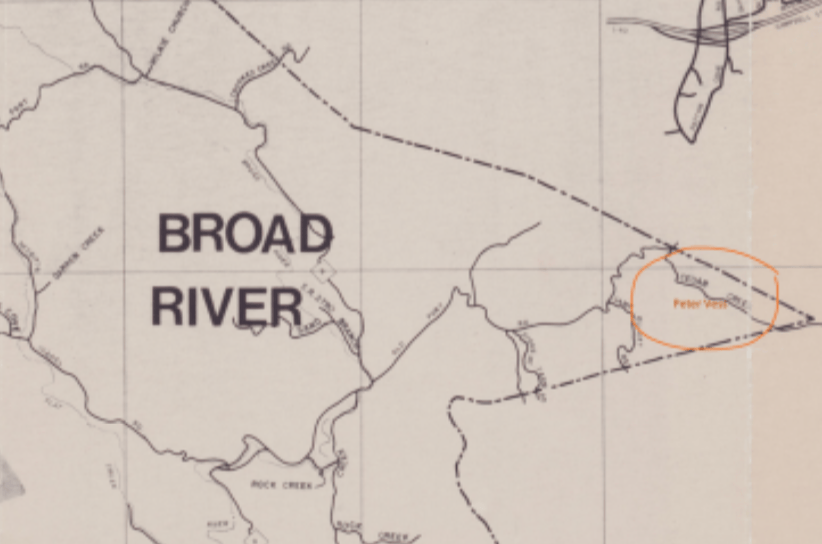
Peter Vess obtained land on Cedar Creek in Rutherford County, North Carolina that is now part of Buncombe County (Broad River Township). He entered the claim in 1829 and the grant was officially issued in 1831.
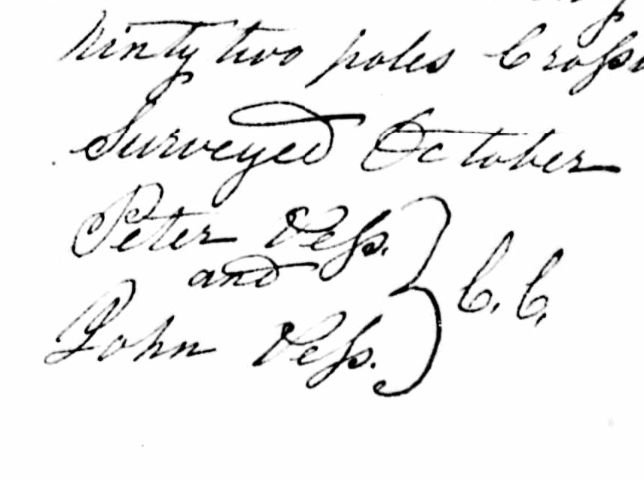
Family researchers noticed that there is a “John Vess” on the land record, which is unlikely to be his son, John Vess, as his son would have been around 11 years old at the time.
In extremely rare cases, an 11 year old could have been listed as a witness, but today, I learned that “John Vess” on this record is not a witness but a Chain Bearer.
Chain Bearers (C. C. )
Names, followed by the abbreviation C. C., at the bottom of survey plat maps mean “Chain Bearers/ Chain Carrier.”
Chain bearers consisted of two adult males, who assisted the county surveyor, by physically walking the property boundaries, using a chain to place down marking pins. The county surveyor administered an oath to both men, swearing to measure the distances accurately and honestly without altering the count.
Chain bearers were often times close relatives (father, brother, adult son, cousin) or next door neighbors, as it was cheaper, than having to the county surveyor hire a local laborer.
What This Information Tells Us
This information tells us that John Vess was a living, breathing, adult relative of Peter Vess who physically walked Peter’s property in Rutherford County, North Carolina.
Chain bearers did not have to be county residents, they could travel from another county or even another state.
In this case, John Vess might be the recently discovered “John Bess” in Spartanburg County, South Carolina with Nathaniel Bess (potentially Nathaniel Vess). If true, they would certainly, without a doubt, be brothers, as we have records of each of their ages! AND, if true, they would have been orphaned (kind of), as “John Bess” is on census with an older woman, who may have been his widowed mother.
John, Peter, and Nathaniel Vess as potential brothers– now that’s intriguing!
Unfortunately, we need more information. BUT, what we do know as a solid fact, is that Peter Vess had a close adult Vess relative (not his son) help survey his property in 1831.
When they say that genealogy requires organizational skills, they aren’t kidding!
I am always casually searching family records, saving anything and everything that interests me to my desktop…that I often later forget about! Seriously!
How I manage to do genealogy at all surprises me, because I seriously lack an organizational system. My version of organized, is a bunch of genealogy “SORT” folders on my desktop, that in total, contain 1,532 files of genealogy records, website links, screenshots, and maps. Half of them aren’t even labeled!
My workspace kind of has that 1950’s detective vibe, a dim lamp that flickers, papers scattered across the desk, scribbled notepads, fifty pens, a stack of resource books, numerous mugs of half-drunken stale cold coffee, chocolate wrappers, and instead of a bulky type-writer, an old hand-me-down laptop with low memory.
I think I can even relate to those moody detectives on tv…we’re cranky, because we store everything in our heads and there’s never enough coffee!
This week, I am organizing my genealogy folder of 1,532 files! It’s a treasure trove of information!
▪︎ Duplicates: I have an enormous amount of duplicate records and screenshots, which probably means they have some kind of important significance – I just can’t quite put my finger on it yet.
▪︎ Maps: I got maps for everything! Because counties often changed, I have all kinds of state and county maps, which helps determine where records could potentially be stored (sometimes more than one county).
My favorite maps are the modern day streams and rivers topography maps, that I use with county maps. Early ancestors often lived near rivers and streams. If an early ancestor lived on a stream/river near the county border, there is a good chance, they’d have records in the neighboring county. While they may be a resident of one county, they might have done business or attended a church, in another, whatever was closest at the time.
Modern topography maps also reveal areas named after early families, that don’t appear on other maps.
However, the best maps, are the old community maps with the names of families listed along waterways, but those are so hard to find!
▪︎ Family Trees: Although I know not all family trees are accurate, they are useful for genetic genealogy. I also use them to look at neighbors of Vess families, to see if any neighboring families have a “Vess” on their family tree.
▪︎ Family Stories: I love family stories! I am a firm believer that every family story has some ounce of truth in it. Extracting the truth is the difficult part!
▪︎ Website Links: At some point, I started saving website links to odd-ball sources (archives, library, online books, family history sites, etc.). These websites are hidden deep in the Internet.
Some are professional websites that you’d never think for a million years would contain family records, others are poorly hosted family websites with fantastic information (even if a little glitchy and probably virus infested).
I discovered a really quirky website once, that locks out visitors who stayed too long, with a pop up accusing them of stealing their family research. It was a good website too, well-sourced, with detailed family tree information.
Unfortunately, there are a lot of family researchers out there, who are very strict gate-keepers of their family history, tree, records, and research.
Not here! Vess genealogy is for everyone! I am happy to share with you all my discoveries, because that’s what makes Vess genealogy so much fun – talking about it!
▪︎ DNA Info: I have a ton of sources regarding DNA, from DNA data to tutorials on how to do genetic genealogy.
▪︎ History: I am pretty sure you can do genealogy without having to know American or local histories, but I find it extremely useful and interesting.
History gives us clues as to where to find our earlier ancestors, by learning about court-house fires, county changes, migration patterns, wars, conflicts, as well as, identify specific areas settled by different groups.
But, also knowing the history of the areas they lived in, the struggles their community faced, and the victories they won, brings our early ancestors to life!
Our early ancestors, whether they were early pioneers, prominent wealthy landowners, farmers and laborers, or even immigrants through Ellis Island, all played a role in American history – and to me, I just think that is fascinating!
▪︎ Newspaper Articles: You’re not going to find too many early Vess ancestors in the newspaper, but you will find a lot of fascinating articles about their neighbors and some of their allied families. Sometimes, family histories were published in the newspaper, going back a couple of generations, which is always super helpful!
▪︎ Memes: Interestingly, I have an unhealthy stock pile of genealogy memes. Just saying.
▪︎ Traditional Genealogy Records: I have census, birth, death, military, probate, bastardy, court, and land records all over the place!
I have so much genealogy to share, I am not sure where to start! I guess that’s why I am spending all week organizing all these files.
Even though I just started going through all these records, I did notice something new….Jonathan Vess was called to court for the same case as Absalom Vess! I also found some more court-cases for Pryor Vess (healways in trouble). I saved a lot of unknown Vess families – that will be fun to go through. AND, I didn’t realize it, but I apparently found a bunch of John Vess (son of Peter Vess) records!
Who knows what other treasures I’ve found, saved, and forgotten!
Please subscribe, so that you can get Vess genealogy directly in your inbox!
There was an early Vess family in South Carolina prior to 1830, but we have yet to identify them, largely due to lack of available South Carolina records and poor literacy. We do know they were there, because we are discovering later Vess families, who claim to have been living in South Carolina prior to 1830.
● Nathaniel Vess stated in his military pension request, that he was living in Spartanburg County, when he enlisted in the War of 1812.
● Polly Vess appears in Greenville, South Carolina as a widow in 1830, living with Joel Callahan. Joel Callahan was a prior resident of Spartanburg County, SC who was listed on the 1790 census next to the Bellew and Gosnell families, and is on Glassy Mountain maps with the Bellew and Gosnell families. Polly Vess is believed to have been the daughter of Joel Callahan, but not confirmed.
● John Vess (1850), husband of Drucilla Turner in Abbeville Co. SC (Greenwood), claims to have been born in South Carolina prior to 1830.
● Another John Vess (1860), states in his Civil War record that he was born in South Carolina prior to 1820 and comes from Greenville, South Carolina.
● Descendants of Nathaniel and Jonathan Vess are adamant that Jonathan Vess was in South Carolina prior to settling in Texas.
But, where are the records for this mysterious early South Carolina Vess family?
John Bess, Spartanburg County, South Carolina
Records are scarce, and we’ll likely never find solid genealogical proof of their early existence in South Carolina, but if I were to give my honest best guess, after staring at South Carolina records for nearly a decade, I’d suggest the mysterious Vess families of South Carolina are related to JOHN BESS of Thickety Creek in Spartanburg County, South Carolina.
Oddly enough, I might have found some additional information to support it…
John Bess hit my radar a few years back, when I saw him on census near the Dunaway and Cantrell families.
This intrigued me, because I have a cluster of shared DNA matches with descendants of Samuel Dunaway and Isaac Cantrell on my paternal side, that I can’t explain.
My best explanation, is that my connection to Dunaway/Cantrell is probably through one of the descendants of John Alexander Vess (son of Andrew Logan Vess and Linna Halford -my 3rd great grandparents) who settled in Spartanburg County, South Carolina from North Carolina. I imagine one his descendants, somewhere, married a descendant of Dunaway and/or Cantrell when they lived in South Carolina.
However, reviewing Ancestry-Thru Lines, I have 4 (distant) shared DNA matches with descendants of Nathaniel Vess. Extremely distant (1%), suggesting that connection is somewhere 8-12 generations back (so probably before Peter). Interestingly, we all have shared DNA matches with descendants of Isaac Cantrell (not so much Dunaway) via Reuben Cantrell of Spartanburg County, South Carolina. AND, John Bess was neighbors with Reuben Cantrell.
I don’t know if that is just coincidence or a potential discovery. But, intriguing nonetheless.
Sebastian (Boston) BEST Family
There are a couple of Ancestry trees that show John Bess of Thickety Creek, as the son of Sebastian (Boston) Best from Lincoln County, North Carolina; however, none of them have supportive genealogical records to see how they came to that conclusion.
Majority of Sebastian (Boston) Best family trees online, do not connect their family to John Bess in South Carolina at all.
The Sebastian (Boston) Best family does have records under the “Bess” name; which is frustrating when you are looking for a “Vess,” whose surname even today is often mistaken as “Best” or “Bess.” But, fortunately for us, they were a prominent early pioneer family, whose family history has already been extensively researched by their family.
So…with that said, looking at the BEST family tree (those with documentation, of course), show several potential John Bess/Best candidates. However, there doesn’t seem to be any records to suggest any of them having ever lived in South Carolina.
While the Best family from Lincoln County, North Carolina owned land in Spartanburg County, South Carolina, many of their records strongly suggest (some even clarify), that they were not residents of South Carolina.
John Bess 1800 Census (Female Widow): Observation
On the 1800 Spartanburg County, South Carolina census, John Bess appears to be between 16-25 years old, living with a female who is 45 years and older, suggesting, she is probably his mother or mother-in-law, who is probably a widow.
Interestingly, if you compare this to the Sebastian (Boston) Best family tree (those that are well documented), we see that the potential John Bess/Best candidates, were either not born yet, too young to be on census, and/or had both living parents at the time.
Nathan Bess: Excused Jury Duty 1818
There is a Nathan Bess on the 1818 Jury Duty list, who was later excused from jury duty. The courts did not indicate why people were excused, but generally, they would excuse them, if they didn’t own land, were sick, or were no longer residents of the county.
Nathan Bess, I imagine, is likely related to John Bess.
The courts pooled jurors from the State Poll Tax, which included all male adults (21 and older). However, those pooled, that didn’t own land, were sick, or no longer a resident of the county, were often excused.
*The Sebastian (Boston) Best family do not appear to have a Nathan Bess/Best on their family tree.
Herron Estate Record 1811
But, the most intriguing record of them all, is a probate estate account for John Herron, which appears to list financial transactions related to his estate, and it includes John Bess.
Records indicate that John Herron’s wife is named Judith, and we see her on the 1810 census as a widow, on the previous page from John Bess (John Beas).
Who is John Herron? Any relation to Andrew Heron, father of Elizabeth and James Heron of Patrick County, Virginia, who were also close neighbors to the Vess family?
Cherokee County, South Carolina (Same Geographical Area)
Thickety Creek is located in today’s Cherokee County.
The record with Samuel “Vest” dated 1800, was for a property on People’s Creek, which is also located in today’s Cherokee County.
I currently believe that Samuel “Vest” is Samuel Vess from Patrick Country, Virginia, who disappeared from record, with the other Vess families, after 1797.
But, even more interesting, is that according to the military pension request from Nathaniel Vess, he stated he enlisted under the command of a “John Gaffney” and “Col. Richard Arnold,” who couldn’t be verified; therefore, his pension was denied.
Nathaniel probably meant Captain “Michael” Gaffney, whose company included a lot of Thickety Creek and Peoples Creek residents. There is no record of a John Gaffney – believe me, I’ve searched for years!
Col. Richard Arnold was likely Richard Arendell (another name for Arnold) and he has a deed entry before Thomas Phillips, where we see Samuel “Vest.” There are no records to suggest Richard Arendell / Arnold was ever a Colonel.
Again, not sure if it’s just coincidence or if it has any significant meaning, but it is an intriguing observation, nonetheless.
Could This Be Jonathan and Nathaniel Vess?
First off, I am 100% confident that Nathan “Bess” in 1818, Spartanburg Co. SC, is our Nathaniel Vess.But, I’m not 100% confident John Bess is our Jonathan Vess.
Jonathan Vess married Elizabeth Heron in 1792 Patrick County, Virginia. We see him in Wilkes County, North Carolina in 1803, but we don’t see him again, until 22 years later in Lincoln County, Missouri, prior to settling in Texas in 1829. We’re missing 22 years of his life!
Descendants of Jonathan and Nathaniel Vess are adamant that Jonathan and Elizabeth Vess were in South Carolina prior to settling in Texas.
BUT, there is clearly an age difference between Jonathan Vess and John Bess- comparing records. SO…my best guess, if John Bess is truly a VESS, is that John and Nathan Bess could be brothers; probably sons of Samuel and Catherine Vess, who I believe is “Samuel Vest” in the 1803 Spartanburg Co. land record for Thomas Phillips.
This John Bess, if a Vess, could also be the mysterious older “John Vess,” we see on Peter’s 1830 land record in Rutherford County, North Carolina, as Peter’s son, wouldn’t have been old enough to be listed as a witness.
So, where does that put our Jonathan Vess? Well…Jonathan Vess could be the oldest son of the oldest William Vess in Patrick County, Virginia (instead of Samuel Vess), with Pryor and William Vess, being the children of the youngest William Vess. I discovered a record showing a William Vess Sr. and a William Vess Jr. (Too many darn William’s).
While I don’t know how everyone is related (as I keep finding more and more of them), I am confident that there are multiple generations of Vess families in Patrick County, Virginia between 1780-1797.
But, again… descendants of Jonathan and Nathaniel Vess are adamant that Jonathan and Elizabeth Vess were in South Carolina. AND, I agree!
Jonathan and Elizabeth “West” of Greenville South Carolina
We know that Peter Vess and his wife, Margaret Vaughn, were listed under the “West” surname in Wilkes County, North Carolina between 1800-1803; so, there is a possibility, that Jonathan and Elizabeth Vess, may also be temporarily hiding behind a “West” surname too, possibly in South Carolina.
More South Carolina Records Coming Available
A few years ago, South Carolina had very few available online records, but genealogical websites like Ancestry, FamilySearch, and even the South Carolina Department of Archives have recently updated their databases to include more records, searchable via index and AI.
As more records become available, we might, someday, bring some light to the mysterious early Vess families of South Carolina.
Family stories are one of those things genealogists love, but are discouraged to use in their research, due to the fact family stories are not always accurate, most of the time exaggerated, or made up entirely. But, I am not like most genealogists…I’d like to believe that family stories still contain some ounce of truth, even if it’s hidden deep behind the fluff.
—–
A long time ago, a descendant of David Andrew Vess (Peter Vess and Catherine Crook line), shared with me a fascinating story about how the Vess family followed and adored a red-headed outlaw.
We were discussing O’Donnell-Vess, which you may have seen on some Vess family trees online. I was told that “O’Donnell -Vess came over from Ireland with an O’Neil, and that our Vess family followed and adored a red-headed outlaw (Mac Hugh or something, named for his red hair).”
Red Hugh O’Donnell
We now know Peter’s family was heavily influenced by his wife’s side of the family, who were of Irish and Scottish descent. Her Irish father, John Crook, would have certainly passed down the story of The Nine Years’ War (1693-1603), involving the O’Donnell’s and the O’Neill’s.
“Red Hugh O’Donnell,” was a real person from Donegal Ireland. He was rivals against the O’Neill family from Tyrone, Ireland. Red Hugh was in-prisoned by an English Lord in Dublin Castle, but later escaped with the help of the O’Neill family.
This story is significant, in the fact, that it teaches the next generation, to stand up for what is theirs, even if they lose everything; symbolizing pride and survival.
It appears, that at some point, the Vess and Crook family stories merged, and we got the “three Vess brothers from Ireland.”
While Jonathan, Peter, and Nathaniel Vess did exist, and genealogical records suggest they might have been brothers, we can safely say, through Y-DNA testing, that the Vess family is not of Irish descent, but of Norman/English descent.
John A. Murrell – The Great Western Land Pirate
Although O’Donnell and O’Neill were officially declared “outlaws” by the English Crown during the Nine Years’ War during the 16th century, there is no evidence to suggest they had a direct connection to a Vess family.
In 1835, a pamphlet titled, “A History of the Detection, Conviction, Life and Designs of John A. Murel, the Great Western Land Pirate,” began circulating through newspapers, documenting a man named Virgil A. Stewart and his experiences with a William “Vess,” who Virgil A. Stewart claimed was an associate of John A. Murrell a.k.a, The Great Western Land Pirate.
This widely circulated conspiracy, may have largely influenced the Vess family story that our “Vess family followed and adored a red-headed outlaw,” as there was a “Vess” connected to the conspiracy of John A. Murrell, an outlaw, who just so happened to be a red-headed, who historians say had “followers,” not gangs, who sympathized with him.
Whether the Vess family actually knew William Vess, or if he had been a relative, is still under investigation.
Oral Traditions
I love oral traditions and this is still one of my favorite Vess family stories, even if it might have been influenced by an Irish tradition and an American bandit.
But, who knows…maybe there is an O’Donnell-Vess I have yet to find, that was the true basis of this Vess family story.