I am so thrilled to have finally reached a new chapter in Vess Genealogy!
When I started this blog last Fall (August 2020), it was simply just a place to organize digital sources and share my genealogy experiences researching the Vess name. I gave it 2 months!
Remarkably, Vess Genealogy kept on going! I never would have ever imagined I would get to work with so many different people interested in the VESS name nor get an opportunity to meet so many different VESS families! This has been such an amazing genealogy adventure!
A HUGE THANK YOU to everyone helping me unravel the mysteries of the VESS family!
If New To Vess Genealogy, Here’s What You Missed!
For generations, three different VESS lines (maybe more) haven’t been able find their ancestors prior to 1820. A frustrating endeavor leaving many of us to just give up.
However, since last Fall, we achieved the following:
1. We learned more about Peter Vess and his family. 2. We learned a lot about Andrew Logan Vess and his family. 3. We likely uncovered Nathan’s origins in the Dark Corners of South Carolina. 4. We discovered that Peter and Willis Vess are closely related and that our family is closely related to the Travers family! 5. We explored families in Knob’s Creek from Peter’s 1820 census record. 6. We discovered “Vess” records in Virginia connected to an unknown Vest/Vess family! 8. We confirmed (via DNA) that the VESS family is not related to the BASS, BEST, WEST, or VEST families; eliminating them as possible family connections.
Brief Recap On Vess Genealogy
We now know that Peter, Willis, and Nathan Vess are related; however, we have not yet determined how they are related to each other.
Peter and Willis were born in North Carolina and Nathan was born in South Carolina. Peter first appears on record in Rutherford County, North Carolina in 1820 on Knobs Creek with the Toney, Pettit, and Mooney families (all members of Bill’s Creek Baptist Church).
Nathan’s first appearance on record is also in Rutherford County, North Carolina, but in 1830 with his in-laws, the Bellew family. The Bellew and Gosnell families are related and are prominent families in Glassy Mountain, Greenville County, South Carolina (aka Dark Corners). Also, Peter’s grandson, David Andrew Vess married Magnolia “Maggie” Gosnell, who is related to Nathan’s wife, Clarinda Bellew.
Willis first appears on record in Franklin County, Alabama in 1830. According to Anna Popejoy, long time researcher of the Vess and Whitlock families, states that the father of Willis Vess (John Vess) had been living in Foxtrap since 1819. Y-DNA analysis, via familytreedna.com, confirms Willis Vess and Peter Vess (Andrew Logan Vess) are definitely part of the same VESS family.
Familytreedna.com (FTDNA) also shows that the VESS and TRAVERS family are closely related; however, we do not know how they are related. There are several reasons as to why FTDNA may group two different surnames closely together; either we are extremely close cousins, one family that split apart during a time before surnames, or a male Travers ancestor took on the Vess name (orvice versa).To unravel this mystery, it would be extremely helpful to have more male Vess descendants participate in Y-DNA Testing.
The Travers family is from Lancashire, England and they have traced their family to Dorchester, Maryland. Whether there is a connection between the Vess and Travers family in Colonial America has yet to be discovered (the families may have split long before they arrived in America).
With the help of Y-DNA and documented family histories, we’ve been able to eliminate the BASS, BEST, WEST, and VEST families as potential ancestors for the Vess family.
The BASS family has a rich Native American background. The BEST family (original surname BOSCH) can trace their family back to their arrival in the 1740’s with the Ecker family (in-laws) from Germany. The WEST family has been ruled out by their extensive West Family DNA Project. And the VEST family, descendants of John Daniel Vest belong to an entirely different Haplogroup than our VESS family. To my knowledge, there is no available DNA information on the VASS/VOSS/ VAULX families.
We have recently discovered a VEST/VESS family in Patrick County, Virginia who may be related to the VEST/VESS family in Rockbridge, Virginia. We have yet to find any records suggesting that they may belong to the VEST family (John Daniel Vest), which is extremely encouraging for our VESS family, andtherefore a new chapter begins!
I am in the process of investigating the Life of Willis Vess and hopefully, with any luck, we can uncover some of Anna Popejoy’s research to help us! I plan to explore more families in and surrounding Patrick County, Virginia – including Surry and Stokes County, North Carolina. All in addition to finding out more about the VOSS/VASS/ VAULX families who seem to live very close to the TRAVERS family in both Dorchester, Maryland and the abolished Albemarle County in North Carolina.
We so badly want to connect our VESS family to William Tunwell VESTof Stokes County, North Carolina; mostly, because it seems to be the only thing that makes the most sense!
While researching Willis Vess in Alabama, I took a slight detour back to the VEST family of Virginia, because I discovered a VEST family 2 counties east of Willis Vess taunting me with records as early as 1818. I had to figure out who they were.
Long story short, I searched for every early VEST record I could find in Virginia and started plotting them on a map. Then, with the help of Y-DNA information provided by a fellow researcher, I started the process of elimination. The final results surprisingly revealed another VEST / VESS family!
Why Does William Tunwell Vest Seem Like A Connection?
Despite having BEST, VOSS, and VASS families also in North Carolina to consider, I was hoping there was a connection with William Tunwell VEST; mostly, because he makes the most sense for the time, place, and names.
Peter Vess Peter Vess of Rutherford County, NC was born between 1791-1794 in North Carolina and most of his records are found under the “VEST” surname; except for the 1830 census (Voss) and his 1831 land record (Vess).
After his death sometime before 1844, the “VEST” surname continued with his wife Catherine and their sons, as shown in Bill’s Creek Baptist Church: Two Hundred Year History, by Helen M. Lu. It wasn’t until 1849, when the “Vess” surname really stuck, in both census and church records. Therefore, it is easy to assume that Peter maybe connected to the VESTfamily.
We were even 100% confident that we had discovered his connection with the VEST family when we found a Surry County War of 1812-1814 record listing a “Peter VEST.” Not only is Surry County right next to Stokes County in North Carolina, but also the names of the other soldiers listed with Peter VEST seem to have connections with the grandchildren of William Tunwell VEST through his son Isham VEST. Because there doesn’t appear to be any VEST families in Surry County, the VEST family next door (in Stokes County) seems like a good fit.
A possible connection to William Tunwell VEST became even more enticing when records for Peter Vess suggested his father may have been named John Vess (1831 Rutherford Co. land grant record). According to the Last Will and Testament of William Tunwell VEST (1812), he just so happens to have a son named John VEST!
Willis Vess William Tunwell Vest also seems like a potential ancestor to Willis Vess.
Willis Vess was born in North Carolina (abt) 1810, supposedly to “John Vess and Maragaret Vaughn” who are said to have also been born in North Carolina. Because William Tunwell VEST had a son named John VEST, it appeared there could be a connection; however, John VEST married Eliza RAY (not Margaret Vaughn). Of course, John could have been married twice, but records show us that John VEST (despite who he was married to) appears to have been living in North Carolina (or Indiana-whichever source you pick) during the time that the father of Willis Vess was living in Alabama; therefore they must not be the same person.
Nathan Vess Interestingly, there haven’t been any plausible ideas between William Tunwell Vest and Nathan Vess. Because Nathan was born in South Carolina, one could possibly conclude he is Peter’s cousin rather than his brother. So, Nathan’s lack of connection to the VEST family in Stokes County, NC never really seemed like such a big deal.
The VEST & VESS Families Are Not Related
According to information from FamilytreeDNA.com, the VEST and VESS families are not related! In fact, they don’t even share the same Haplogroup!
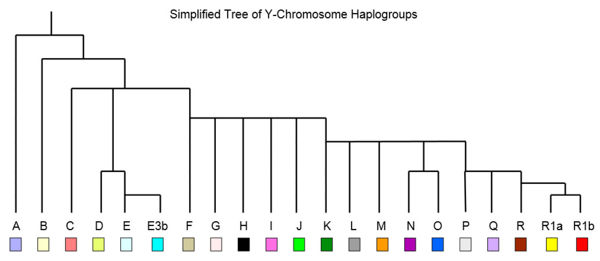
The descendants of John Daniel VEST (VEST family of Virginia) belong to Haplogroup-I, whereas the descendants of Willis Vess and Andrew Logan Vess (our VESS family) belong to Haplogroup- R (R1a). That’s quite a distance from each other on the Y-Haplogroup tree.
So, we can pretty much eliminate any VEST family related to John Daniel Vest as being possible ancestors, including William Tunwell VEST of Stokes County, North Carolina.
I was holding onto William Tunwell VEST for a long time, just in case; however, I eventually discovered that he is the son of John Daniel VEST.
In the Last Will and Testament of John Daniel Vest (1765) of Chesterfield County, Virginia, John names his wife “Ann Vest” (likely Charolette Ann Bakes) as well as his 7 children: “John Vest, Valentine Vest, Elizabeth Vest, James Vest, George Vest, Phillip Vest, and William Tunwell Vest.” [Transcribed by Sandra Lake Lassen March 1993 – Ancestry.com]
By the way, I discovered the VEST family near Willis Vess in Alabama are descendants of John Daniel Vest through George Washington Vest– so, no relation to Willis Vess.
Mapping VEST Families
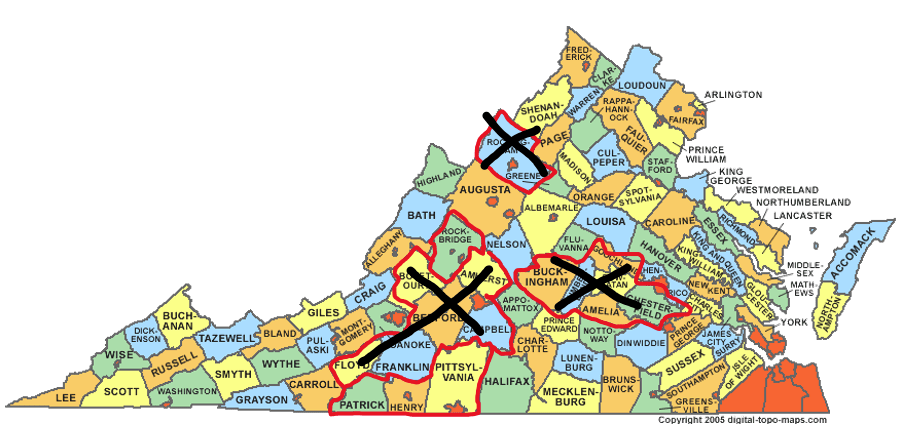
Instead of trying to untangle the many different branches of the VEST family, I decided it would be better to us their records to plot them all on a map. During this process, I came to discover that a lot of VEST families do seem to be descendants of John Daniel Vest and Charolette Ann Bakes. The family appears to have originated from Chesterfield and Powhatan County, VA and then migrated westward into Bedford County, then down into Franklin and Floyd Counties, before conquering the rest of the United States.
After finishing my map, two VESS/VEST families who do not seem to have any connection with the John Daniel Vest family stood out!
The Map The counties [below] highlighted inredcontain VEST records. The counties marked with an X have records that strongly suggest a relationship with John Daniel Vest. And, the counties left, with no X, have records with both the VESS and VEST surname.
This map is not 100% accurate. It is very likely that there are areas and families I missed; especially, since documentation of these VESS-VEST families is scarce and require deep digging into Virginia archives. The purpose of this map is to see if we could identify any “separate” families, such as those using the VESS surname.
Exploring VESS/VEST Families
Rockbridge County and Patrick County, Virginia are the only two counties where I have found records with the VESS name and families whose records seem to use the VESS and VEST surname interchangeably, and interestingly, neither of them seem to have any records that suggest (at this time) they are connected to the John Daniel Vest family! So, who are they and do they have any connection to our VESS family?
VESS/VEST family of Rockbridge, Virginia
According to my ancestral DNA, I have distant DNA-relatives who are descendants of Addison Vess of Rockbridge County, Virginia through my VESS line. My project, of course, could be flawed as the connection could be distant, possibly connected between different families related to Addison Vess.
However, I used the same search method again for the VEST name and more DNA-relatives came up; all related to Vess families in Rockbridge, VA. I did not get any DNA-relatives descending from the John Daniel Vest family.
The Vest/Vess family living in Rockbridge are found near Colliers Creek and Kerrs Creek. Library of Congress Looking at this map [below], there are family surnames that I recognize from bits and pieces of my research on the Vess family: Hostetter, Ailstock, Noel, Morris, and Tolly, and Armstrong.
William, Peter, & Samuel VESS/VEST of Patrick County
As mentioned in a previous post, “What We Know So Far,” we recently discovered a Vess/Vest family in Patrick County, Virginia who we have no idea (like the Rockbridge family) as to whether they are related to the VESS or VEST family (perhaps neither).
I was provided a list of land deeds for Patrick County, Virginia (1791-1801) to compare to the residents in Tryon County, North Carolina (1769-1779) to see if there was any kind of connection. Unfortunately, I did not find anything significant, for that Tryon County records are much older than the Patrick County records and it just wouldn’t make sense that families would travel so far south just to end back up North. I guess they could have, but probably unlikely during a time when families were migrating out west and down south.
The records we find in Patrick County, Virginia include a William, Peter, and a Samuel Vess (VEST/VOSS) who lived on the border of Patrick County and Henry County (as shown on the mapbelow) in Bull Mountain, North Mayo River, and Koger Creek, just below Franklin County, Virginia.
These records also show family surnames that I recognize from bits and pieces of my research on the Vess family: Duncan, Dodson, Willis, Watson, Reynolds, Sharp, Hooker, and Randal.
HAIRSTON & PENN Families: A Little Local History While researching some of the families on this deed list, I discovered that the HAIRSTON and PENN families (both on the deed list) have a bit of history in the area.
George HAIRSTON built Beaver Creek Plantation which was a tobacco plantation and a very large slave-trading post in Martinsville, VA (east of Koger Creek in Henry Co.). He served under Col. Abraham PENN who was the original owner of the land that George Hairston built his plantation on (using a royal grant). The PENN family built “Poplar Grove” plantation in Patrick County, VA near Patrick Springs (west of North Mayo River). And both HAIRSTON and PENN families married into the STOVALL family- all connected.
There appears to be several plantations in the area, all of which utilized slaves and indentured servants. Indentured servants generally had a 7 year contract and in return for their service, their masters often granted them land. Looking at records on Patrick County, VA Genweb, we find deed records referred to an “Indenture,” where land was transferred to the “apprentice” after all debts and terms of their contract have been satisfied.
Jonathan William Vess of Texas: Koger Creek According to the deed list, William Vess/Vest is shown near a Herron/ Heron family and as previously known, marriage records show Elizabeth Herron having married Johnathan William Vess in 1791 in Patrick County, Virginia. Johnathan William Vess and Elizabeth Heron traveled with Stephen F. Austin from Missouri to Texas (Republic of Texas) during the 1820’s. This William Vess/Vest on the Patrick County deed list may either be Jonathan himself or perhaps his father.
Peter Vess and William Vess/Voss: North Mayo River According to the deed list, west of Koger Creek are residents of the North Mayo River which includes Peter Vess, William Vess/Voss, Samuel Vess, William Willis, and William Sharp.
This Vess/Voss family is most interesting for that we see them with the Willis, Dodson, and Sharp families (family surnames that are also found in Franklin County, Alabama with Willis Vess).
To make things even more interesting, we found a 1785 marriage record for Peter Vess and Pugnance Vaughn in Henry County. (Henry County is next to Patrick County, and there was a time when both counties were one, called Patrick-Henry County)
What is interesting about this, is that according to Anna Popejoy, the parents of Willis Vess were John Vess and Margaret Vaughn. To this day, we do not know where she got this information; however, we are now wondering, if this is them.
Perhaps their full names were John Peter Vess and Pugnance Margaret Vaughn??? Also note, that the brother of Willis Vess is supposedly “John Peter Vess,” perhaps he was a John Peter Vess Jr.?
In addition, records also show land transactions between Peter Vess and Samuel Vess via John Duncan. At the bottom of this particular deed list (with Peter and Samuel), you will also find a Whitlock family.
Are These VESS/VEST Families Related
It is plausible that the Rockbridge VESS/VEST family and the Patrick County VESS/VEST families are related to each other, for that records of the Patrick County family (earliest record 1785) come before the records of the Rockbridge family (earliest record 1818); suggesting one of the Vess members may have migrated to Rockbridge, Virginia from Patrick County, Virginia.
It has also been observed that Samuel Vess of Patrick County, Virginia disappeared before Peter and William Vess; which makes us wonder if he is (or is related to) Samuel Harvey Vess of Rockbridge, Virginia (1830 records).
We do not know if they are genetically related to the our Vess family; however, genealogical records seem to support some kind of connection.
Full Recap
The Vest family of Virginia and our Vess family are not related (two separate Haplogroups).
There is no genetic relationship between our Vess family and William Tunwell Vest in Stokes County, North Carolina.
Maps reveal a separate VESS/VEST family residing in Rockbridge and Patrick County, Virginia. It is not yet know if these two VESS/VEST families are related, but it is plausible considering the record dates.
We have likely discovered the families of Jonathan William Vess and Elizabeth Heron (of Republic of Texas) in Patrick County, Virginia on Koger Creek.
We have discovered that there is a Peter, Samuel, and William VESS/VOSS on the North Mayo River with a Willis, Sharp, and possibly a Whitlock family.
The area in which we find these families in Patrick County, has a history of plantations and records that suggest some of the land owners were once indentured servants.
Many family surnames found in both Rockbridge and Patrick County, Virginia are familiar names seen elsewhere in Vess family research; especially, regarding Peter and Willis Vess.
No definite conclusions can be made at this time; however, these new discoveries seem promising! It appears that a new chapter in Vess Genealogy has just begun!
If you are or know someone who is a male descendant with the VESS or VEST surname, please consider participating in Y-DNA testing through FamilytreeDNA.com to help us unravel the mysteries of the VESS family!
Again, a HUGE THANK YOU to everyone who has shared their findings with me on the Vess name in effort to piece together VESS family history!
James Elmer Vess was born on August 18, 1897 to Pinkney Elcanhah Vess and Cora Nevada Moffitt in Old Fort, McDowell County, North Carolina. In 1915, he married Pearl Lena Cox and together they had 10 children. James died on March 31, 1957 in La Grande, Union County, Oregon.
*This post is an opinion, written from a genealogical point-of-view.
The Man Everyone Wants To Forget
I descend from a west-coast Vess line that branched away from their North Carolina roots in the early-1920’s.
When I first got into genealogy, I had no idea the Vess family had deep roots in North Carolina, let alone that we still had a lot of family living there. For all I knew, the Vess family took the scenic route from Ireland to America’s western frontier!
Nobody ever talked about family history (not much to say) and nobody wants or even likes talking about James Elmer Vess!
James Elmer Vess is a man that everyone wants to forget. Just the mere mention of his name often abruptly ended conversations with family. Those who did talk about him, mostly the older generation, were not so keen about him. Nobody would tell me what he did or why he left North Carolina and settled all the way across the United States to Oregon, of all places.
At one point, I was told to “let dead dogs lie,” especially, dead dogs like James Elmer Vess.
Well, I say let’s dig up some old dead dogs and see what secrets they hide!
Exiled From North Carolina
I don’t know the whole story or even a fraction of the whole story, but what I’ve been told is that James Elmer Vess was “kicked” out of North Carolina by his brothers for being a “drunken bootlegger.”
Based on newspaper clippings, that totally makes sense.
James Elmer Vess was undeniably an alcoholic. He often made the papers in La Grande, Oregon (1940’s) having been arrested for “public drunkenness.”
Newspapers.com
I’ve also been told that he wasn’t the most pleasant person in the world; likely due to alcoholism, which only solidified his poor reputation.
The demons that drove James Elmer Vess to drink will never be known, but looking more deeply into family history, we can probably identify some contributing factors…
Moonshine: A Way Of Life
North Carolina, once referred to as the “Moonshine state,” is notorious for distilled liquor, especially in the Blue Ridge Mountains.
People have been distilling liquor long before they broke ground in Jamestown, Virginia; but moonshine supposedly got its start from the Scot-Irish, who supposedly had better methods of distilling liquor. And with western North Carolina having been largely settled by the Germans and the Scot-Irish, it is kind of difficult to imagine a bunch of rugged mountain men as tea drinkers.
In North Carolina, especially, deep in the heart of backcountry, moonshine was the way of life. Farmers produced moonshine, because it was worth more than their most profitable crop and it could help pay off their debts. There was even a time when local churches were somewhat lenient about it; partially, because EVERYONE did it and dismissing members from church would likely leave a church very empty.
Interestingly, we can see this somewhat tolerance towards alcohol in Helen M. Lu’s book, Bill’s Creek Baptist Church: Two Hundred Year History. Many members of Bill’s Creek Baptist Church (Rutherford Co. NC) got in trouble for distilling spirits or drinking too much, including Andrew Logan Vess (James great-grandfather).
According to Bill’s Creek Baptist Church: Two Hundred Year History, Andrew Logan Vess was excluded from the church in 1867 for “distilling some brandy for purpose of paying debts and providing for his family.” [pg. 153]
Andrew Logan Vess wasn’t alone. There are numerous accounts of other members (including his brother Josiah) of Bill’s Creek Baptist Church being excluded for either distilling spirits or excessive drinking, and, surprisingly, very few are shown to have been dismissed from the church.
The history of moonshine in North Carolina is fascinating, as it was part of a community culture that just didn’t mix well with the government (who wanted to tax it) and churches (that see it as sin). The war on moonshine in North Carolina had been an on-going issue since the early 1700’s!
Born At The Wrong Time At The Wrong Place
James Elmer Vess was born in 1897, a time when McDowell County (near Blue Ridge Mountains) was still pretty much backwoods country. According to census records, the highest grade level completed was the 5th grade, which was likely the highest level of education offered at that time in the rural areas of North Carolina.
Without school, who knows what types of trouble kids gotten themselves into back then! I imagine, at a young age, James had friends whose families distilled liquor and this is probably how he got his first taste of alcohol.
By the time James was a teenager, moonshine was a hot business, for that North Carolina began to prohibit the sale of alcoholic beverages in 1908, which was ten years before the rest of the nation. So, what kid doesn’t want to make a little extra cash running moonshine!
In 1920, the federal government enacted a nation-wide ban against the manufacturing, selling, and transportation of alcoholic beverages. Obviously, not the best time for those struggling with alcoholism!
Family Pressures: Moffitt Family Connections
Of all the Vess ancestors I’ve researched, I’ve got nothing on Pinkney Elcanah Vess, father of James Elmer Vess. Records are scarce; but from what I gather, Pinkney E. Vess seems to have been a simple man living a simple life.
In 1889, Pinkney E. Vess married Cora Nevada Moffitt, daughter of Rev. James Ivy Moffitt and together they had 7 children, all sons, with James being the middle child.
[Above Left:Cora Nevada MoffittRight:Rev. James Ivy Moffitt]
James grew up in a religious family with several of his brothers following in their grandfather Moffitt’s footsteps in becoming Reverends.
I was told that all of James brothers had become Reverends (but him) and that it was all of them who kicked him out of North Carolina; however, to my knowledge, it was only his oldest two brothers who became Reverends: Rev. Lennie Oran Vess and Rev. Arthur Lee Vess, and maybe they strongly encouraged James to skedaddle out of town.
With excessive drinking a sin, bootlegging illegal, and being raised in a religious family, James Elmer Vess didn’t stand a chance with his alcoholism.
There was also likely a lot of pressure on James Elmer Vess to be a well-modeled citizen for the sake of his family’s reputation. The Moffitt family had been around for a long time and during that long time, they made some pretty well-known family connections: Murphy, Ledbetter, Ownby, Whitaker, and Bird (that’s just to name a few). They even have a family connection with the Burgin family.
I first encountered the Burgin family in my research back when AOL was a thing and they had a website that mentioned “Pioneer” Ben Burgin having had a “Vess” servant boy. I regret not printing that page, because I haven’t been able to find it again.
Anyway, the Burgin and Davidson families were pioneers of western-North Carolina who once owned lots of land and were also involved in the local government and politics. Simply, the Burgin and Davidson families were kind of a big deal.
Burgin-Moffitt: Mt. Mitchell Railroad
I discovered that Gertrude Moffitt, James aunt (Cora Nevada Moffitt’s sister) married “Big Jim” Burgin, who worked for the railroad. He is distantly related to “Pioneer” Ben Burgin through his third great-grandfather, John Burgin.
I was told James Elmer Vess worked for the railroad, but there isn’t a record of it. However, he may have worked for the Mount Mitchell Railroad.
The history of Mount Mitchell Railroad is short. It ran from 1911-1914 and was mainly built for the logging industry, but was later converted for tourism.
Mount Mitchell is located in Yancey County, North Carolina and according to the marriage record of James Elmer Vess (18) and Pearl Lena Cox (21), they were married in Yancey County, NC in 1915.
Pearl’s family, at the time, was living in Mitchell County, just north of Yancey County in a town not too far from Mount Mitchell.
I assume James likely met Pearl while working for the Mount Mitchell Railroad with his uncle” Big Jim” Burgin . And, while we’re guessing, it’s probably not too much of a stretch to think that James was probably sent to his aunt and uncle as an effort to keep him out of trouble. However, the mountains is where all the moonshine is!
Heading To The West-Coast
From my perspective, it appears that James Elmer Vess cut ties from his family long before he ever decided to leave North Carolina. So, what drove him to Oregon? I mean, that is a lot of distance between bad blood.
I was told the railroad took him and his family out west and according to census records, they must have headed out of North Carolina sometime between 1918-1920.
There doesn’t appear to be a 1920 census record for James Elmer Vess; however, there is one for Pearl who is shown to be in Colorado with her mother (Bertha Cox) and the children.
Looking at this census, there appears to be a lot of lodgers in Colorado working in the railroad industry, so maybe James was missed on the census due to traveling.
It also seems that Pearls parents have split. Her father, Elliot Wood Cox stayed in Mitchell County, North Carolina while her mother, Bertha Cox, found her way to Colorado. I do not know when Bertha arrived in Colorado, or if they all traveled together.
Bertha Mary Krels – Cox
There is also a good chance James Elmer Vess did leave due to bootlegging. It just makes sense.
Instead of his “Reverend” brothers kicking him out; it was more likely the law enforcement, nicknamed the “Revenuers” who were the ones who ran him out of North Carolina. According to the history of North Carolina moonshine, the Revenuers were a group of officials that were tasked to locate bootleggers and moonshiners in real hard-to-get remote places, such as the Blue Ridge Mountains where James had been living.
Settling In Oregon
Birth records tell us that James and his family were in Oregon as early as 1927. But then, it gets interesting.
In 1930, James and his family are in Oregon, working as a farmer, but they also seem to still have a residence in Colorado, according to the Colorado Directory listing for 1931. Probably, because Bertha (Pearl’s mother) was still living in Colorado and they didn’t update their move with the directory.
Also, in 1931, Pearl had their last child in Colorado and I assume it was while she was visiting Bertha. Eventually, everyone (including Bertha) settled in La Grande, Oregon, where I believe James retired from Hart Construction.
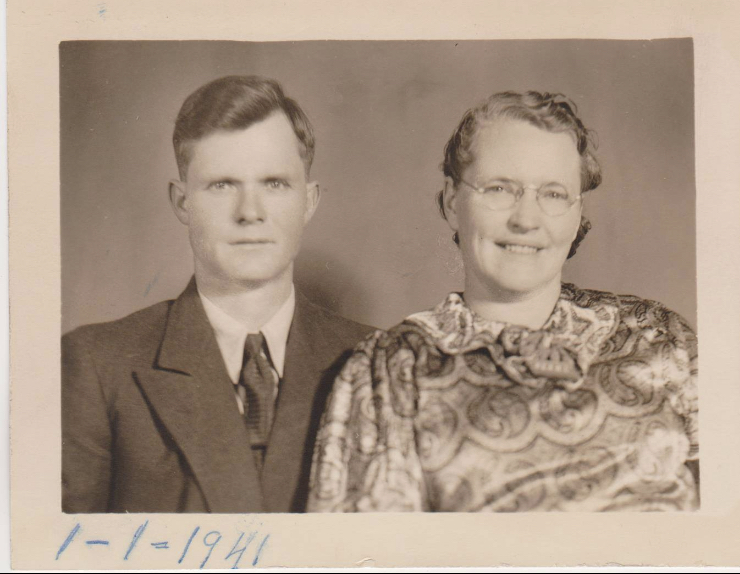
James and Peral 1941
The West-Coast Vess Line
In the 1930’s the railroad industry was declining, which probably explains why he went into the farming industry (1930 census). But, I am not sure if it was just the railroad that took him all the way up to Oregon.
Although majority of Vess families on the west-coast descend from James Elmer Vess, he was actually not the first Vess family on the west-coast.
In fact, the oldest son of Nathan Vess, Andrew Jackson Vess, moved to the west-coast sometime before 1880. They settled in Spokane, Washington. According to census records, it appears that his mother, Clarinda Bellew-Vess moved to Washington after her husband, Nathan Vess, passed away in 1879 due to consumption.
Andrew Jackson Vess and Mary “Polly” Davis Ancestry.com
So, I can’t help but wonder, if at some point, James connected with his Vess cousins (if related) in Spokane, Washington on his way to Oregon. I mean, usually when people move far away, they move to places where there is family.
It’s Vess Family History
It appears that James Elmer Vess embarrassed his family with his alcoholism and bootlegging. We will never know if alcoholism was the actual reason he left North Carolina for that our ancestors took that to their grave.
He could have been kicked out by his brothers (no argument there), but from a genealogical perspective, that seems unlikely. If anything, his brothers probably kicked him out of the family home in McDowell County and maybe in the process they strongly encourage him to leave town.
Instead of leaving North Carolina, he may have went to live with his aunt Gertrude (McDowell County 1910) where he may have later gotten a job at Mount Mitchell Railroad with his uncle Jim Burgin. Working in Yancey and Mitchell County, is where he likely met Pearl, getting married in 1915. A few years after the railroad shut down, WWI records (1917) show James and Pearl still living in Mitchell County. I don’t know when James became a bootlegger, maybe after the railroad shut down (if he even worked for the Mount Mitchell Railroad). Maybe he came to the Blue Ridge Mountains as a teenager to be a bootlegger. We’ll never know.
But, I strongly believe that when James did leave the state (most likely due to bootlegging), the family story about the Revenuers (law officials) was eventually mistaken as “Reverend” and thus, the family story evolved into James having been kicked out by his brothers (who just so happened to be Reverends).
Regardless of what really happened, James leaving North Carolina to settle in Oregon is still part of Vess family history. A big part of Vess family history, for that to the best of my knowledge, James Elmer Vess is probably one of the very few, if not the first, Vess family to have settled on the west-coast who is a descendant of Peter Vess.
A HUGE Thank You to everyone sharing their family’s stories with me and helping me piece together VESS family history! 🙂
I thought I had all the Vess family in North Carolina between 1820-1900 accounted for, but apparently there appears to be two women with the name Elizabeth Vess in which I do not know where they go on the Vess family tree!
To pass time away during this crazy winter-storm event, I decided to just browse through some online documents. I didn’t want to dig too deep in case the power goes out. Nothing worse than stumbling upon something exciting and then the computer screen goes dark! But, browsing is never uneventful for me. So, before the power goes off again, this is what I stumbled upon…
Louisa Elizabeth Vess
I came across an 1864 marriage record for an Elizabeth Vess and William Columbus Lanning in Henderson Co., NC. She was supposedly born in Transylvania County, NC abt 1845 and died in 1879. [Transylvania County was established in 1861 and was previously part of Jackson and Henderson counties]. According to family trees on Ancestry.com for William Columbus Lanning, she was his first wife and they have her name as “Louisa” Elizabeth Vess.
I do not know who this is.
Possibly Peter’s Daughter
My initial thought, is that Louisa Elizabeth Vess is possibly Nathan’s daughter, because parts of Henderson were once part of Buncombe County where Nathan’s family is seen on the census records. Also, a couple years later, his daughter Sarah Jane Vess married Jackson Pressley in Henderson County, NC. But, there is no records of Nathan having a daughter named Louisa. He did have a daughter named Elizabeth though, but she married a Chambers and a Hyatt, and also died in 1915 in Washington. Furthermore, none of his older kids were old enough to have any children prior to 1850. I mean, they could have, but the odds are slim.
So, I looked at Peter’s family next and he has a daughter named Elizabeth born abt 1840, who disappeared after the 1850 census.
We do know that Peter and Catherine’s younger kids were sent to live with other families in 1860, suggesting Peter and Catherine had both passed away. Rachel, Eliza, and Jasper are found living in Buncombe County, NC with a Dempsey Sumners. Zephaniah Vess, their brother, is living with the Whitesides family in Rutherford Co. NC. But, I have not been able to find Elizabeth, suggesting she either got married or went to live with someone else and the census misspelled her surname.
There is a good chance this Lousia Elizabeth Vess is her. I followed the descendants along her line with William Columbus Lanning, and several surnames along that line do come up as DNA relatives; however, none of them have completed trees to confirm a solid connection.
Susan Ann Elizabeth Vess
I came across an 1878 marriage record for an Elizabeth Vess and Columbus McGinnis in Rutherford County, NC. She was supposedly born in Rutherford Co., NC in 1856. Some family trees on Ancestry.com for Columbus McGinnis have her as “Susan” Elizabeth Vess, “daughter of Andrew Logan Vess and Linnia Halford.”
Andrew Logan Vess did not have a daughter named Susan or Elizabeth.
I do not know who this is.
Possibly Peter’s Grand-daughter Via John Vess
You would think any Vess family born in Rutherford County, NC after 1850 would be easy to identify. I guess not.
We can certainly (or so I am confident) we can rule out Nathan’s family. In 1850, he and his family were in Buncombe and Haywood counties. We can also rule out Peter as the father, because research suggests he passed away sometime before 1844. With Nathan on the move towards Tennessee, this Elizabeth Vess may likely be Peter’s granddaughter (if born in 1856).
According to her death certificate (1926), her father is listed as “Andy Vest” and he was born in Rutherford Co too [her mother unknown]. But Andrew Logan Vess didn’t have a daughter named Susan or Elizabeth. The only other “Andy Vess” I am aware of, is Andrew Logan’s son, Peter Allen Vess, who also went by “Andy Vess,” but he was born in 1882. So, if not their daughter, then whose daughter is this??
Well, if I were to guess (I am guessing), I would say she is probably the daughter of John Vess, Peter’s oldest son. Why?
John Vess disappeared from records after 1850. He had 4 children with his wife, Elizabeth Taylor: Sarah, Silus, Mary, Sophrona, who were all born prior to 1850. However, we have record of a divorce in 1854 via local newspaper, implying John Vess had left the state.
Perhaps John hadn’t left the state. Perhaps he was still living in Rutherford County, NC and found someone new and two years later (1856), had a daughter with someone else.
A Little More Digging Is Needed
For all I know, these women aren’t VESS at all. Maybe they are VOSS, VASS, or VEST? OR, maybe I missed someone in Peter and Nathan’s family tree.
Further research is required.
If anyone knows who these women are, please leave us a comment and we can update the family tree. 🙂
I am elbow deep in Tryon County records and thus far, no “Vess” families. They simply do not seem to exist and I have yet to make any connections with the “Vess” family seen in Patrick County, Virginia [1790’s].
There are a lot of interesting families in Tryon County, North Carolina. Many of which are on my “Families of Interest” list, including the Duncan family. They raise an eyebrow, for the fact, there is a Patrick County, VA tax record between Samuel Vess and Peter Vess and Samuel Vess and John Duncan. I do not know if the Duncans in Tryon County, NC are related to the Duncan family in Patrick County, VA.
I keep searching for a Vess-Duncan connection and I may have found one:
Peter’s first 3 sons were born and lived (briefly) in the Knob Creek area. So, I figured, I should take a look as to who they married:
John Vess married Elizabeth Taylor. Taylor family has numerous properties all near Knob Creek and have been in the area since the area was considered Tryon County.
Josiah Vess married Zilla Early. The Early family is complicated, however, Zilla’s mother is Nancy Duncan.
Andrew Logan Vess married Malinda Halford, whose grandfather obtained land on Knob Creek in 1792.
So, from what I can tell, Peter’s sons married into families who likely have settled in the area when it was considered to be Tryon County. However, further research is required.
Zilla’s family doesn’t seem to have any connection to Bill’s Creek Baptist Church (they were not early members with Peter). It may not be too much of a stretch to consider that the Vess and Early families knew each other outside of church; either they attended another church together, were neighbors, or migrated together (there are Early families in SC).
I need to do further research on these families. I need to finish mapping out all these families to see if there are any visible connections there. I am confident I am on a roll! Tryon County has opened up so many different doors, I just don’t know where to begin! 🙂
The earliest record I have on Peter Vess (Vest) is his 1820 census record for Rutherford County, North Carolina.
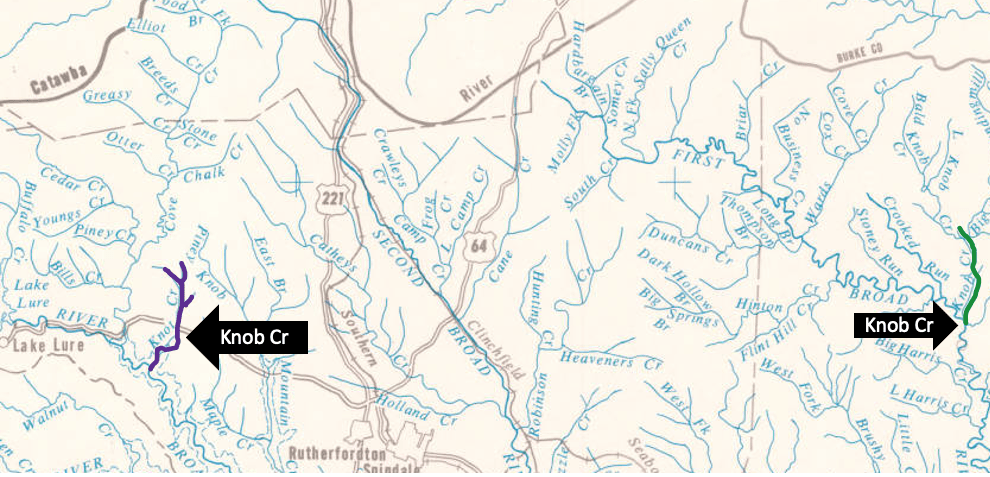
I have determined that he was living on “Knob Creek” in 1820; however, according to a map of the Broad River Basin, there are two Knob Creeks. One closest to Bill’s Creek (Bill’s Creek Baptist Church) off the Main Broad River and one closet to Lincoln County off the First Broad River.
I have researched all the families listed on the same census page as Peter and I have yet to confirm which Knob’s Creek Peter was likely living on in 1820. However, I have compared all the names, top to bottom, on the same census page [pg. 377] to the Member list dated 1829-1836 [pg. 115] in Helen M. Lu’s book,Bill’s Creek Baptist Church: Two Hundred Year History, and discovered something remarkable: 1820 Rutherford County Census.
Esom Logan Peter Vest David Mooney Henry Petit (not sure if this is Sr. or Jr.). If it reads “Esq.,” it would be Jr., because he was a Judge. James Young Abraham Toney Francis Young
These men [above] are the only men on that census page (interestingly grouped around Peter) that are connected to Bill’s Creek Baptist church between 1828-1836. Are they neighbors or family?
David Mooney’s children become members in the 1830’s. Peter Vest and Abraham Toney were members between 1829-1836. Henry Pettit Sr. became a member in the 1830’s and Jr. was dismissed in the 1830’s (does not say when he became a member). James Young has records as early as 1828, but does not say when he became a member as records prior to 1827 have been lost. James and Francis Young are related. Esom Logan has family who become members of Bill’s Creek Baptist Church in the 1850’s, but he is listed as a person of interest due to his connection with James Logan, in which I will explain in a bit…
Knob Creek – Mooney Families
This is where it gets complicated! I only have bits and pieces of the puzzle and so I don’t know how it all fits yet...
David Eaker MOONEY (Mauney) is a descendant of Hans Jacob Mauney/Mani from Switzerland (Palatine Immigrants who arrived on the ship Lydia) and is related to Christian Mauney who used his home as the Tryon County courthouse and jail.
To learn more about the Mooney/Mauney Families click here.
There is a 1798 Rutherford Co. land record for David Mooney, George Mooney, and Henry Site for 150 acres on the branch of “Knobs Creek.” Again, I don’t know which Knobs Creek, but if I were to guess, I would assume it is Knob’s Creek near Christian’s property south of the Catawba River closest to Lincoln County; instead of the Knobs Creek closest to Bill’s Creek Baptist Church.
I also looked at other names on the 1820 census list (a page back and a page forward) to find other land owners to get a better idea on where their properties were in relation to both Knob Creeks on the map, in effort to determine which Knob Creek Peter was likely living on at that time.
Interestingly, the few land-owners that I found on the census record all had land records for properties closer to Lincoln County, along the First and Main Broad Rivers where other Mooney properties can be found: In short, Peter may have been living on the Knobs Creek closest to Lincoln County [green above].
The Mooney, Pettit, and Toney Families Are Related
Not only are there connections with Bill’s Creek Baptist Church, but there are family connections too…
David E. Mooney is not shown as a member of Bill’s Creek Baptist Church, but his son Asa Mooney becomes a member in 1834 [pg. 117, Lu] and Asa married Anna Pettit, daughter of Henry Pettit Sr. [above on census].
Henry Pettit Sr. was received by Bill’s Creek Baptist Church in 1833. His daughter Sarah Pettit is married to Abraham Toney [above on census] and their daughter Elizabeth (Betty) Toney is married to David Mooney’s son Felix Mooney. Other sources say Felix is David’s grandson, but either way, they are still related. In fact, the Mooney, Toney, Pettit tree is complicated with numerous relationships! I strongly believe all three of these families lived together on Mooney’s land.
Also, it would not surprise me, if one of Peter’s daughters married into that web of families. Note:Peter had 3 daughters and there are no records as of yet showing if they ever married; however, for one of his daughters (Elizabeth, I believe) disappears after the 1860 census which may suggest a name change due to marriage.
Mooney, Best, and Gosnell Family Connection
Of course, it gets more interesting…
Without a map of the Broad River Basin, I would have never realized how close the Mooney, Best, and Gosnell families were together! It was when I started to read land surveys that I found them to be close neighbors! Like their properties backed up to one another!
When Tryon County split into Rutherford and Lincoln County in 1779, the Mooney family ended up in the Rutherford County side while the Best and Gosnell families ended up on the Lincoln County side. This is why early census records have them county’s apart; without a map their connection is greatly missed! Further research shows the Mooney family also having land in Mecklenburg Co., but I cannot remember if they are neighbors with the Best family (I have to check the land survey’s again).
Lincoln County 1790 census: Boston BEST & Charles GOSNELL
Another interesting family to come into view is the VINZANT family! The 1790 census shows Gosnell and Best next to each other in Lincoln County. David Mooney is on the 1790 Rutherford County census, next to a Vinzant family who, by the way, Henry Pettit Sr., obtains land from in 1824! I don’t know who the Vinzant/ VanSandt family is yet, but I sure do hope to find out!
The Best Family Are Palatine Immigrants Too
I know the Best family came from Pennsylvania according to a North Carolina census record on Genweb. Further research states that their original surname is “Bosch” and recent research now suggests that I should be able to find their arrival somewhere in the same book as the Mooney [Mani] family! Pennsylvania German Pioneers: A Publication of the Original Lists of Arrivals in the Port of Philadelphia from 1727 to 1808, Vol. I They may have arrived a few years after the Mooney family as I do not see the Bosch family listed on the same passenger list with the Mooney family posted on Olivetreegenealogy.com. [See: Jacob Mani and Peter Ecker]
On the passenger list with Mani and Ecker is also a John Peter Weiss (maybe that is a Vess?). Maybe it wasn’t John, Peter, and Nathan, but John Peter! Dunno! 🙂
South Carolina Pasts
The Gosnell, Mooney, and Best families were close neighbors (on map). There are no records of the Gosnell family being members of Bill’s Creek Baptist Church, which may suggest that the Vess family may have been close friends of the Gosnell family prior to the 1820’s, either through a different church, possibly as neighbors, or they migrated together.
Remember: Nathan Vess married Clarinda Bellew whose mother is supposedly Clarinda GOSNELL. Also, the Tyger River Baptist Church in SC (part of Tryon County) and Bill’s Creek Baptist Church were both members of the Bethel Association.
The Gosnell family is from Baltimore, Maryland. Charles GOSNELL settled in Greenville County, SC, more specifically, Glassy Mountain, SC. You can learn more about the Gosnell family in Baltimore County Families: 1659-1759 by Robert W. Barnes on Ancestry.com (pg. 270). It mentions how Charles GOSNELL moved to Greenville County, SC and also briefly mentions the marriage of Judith BELLEW as the wife of Joshua Gosnell. The Bellew and Gosnell families were popular in Glassy Mountain, SC and you can read about how I found them in the Dark Corners here.
There is a list of reoccurring family names in which we don’t exactly know their connection to the Vess family (if any):
We assume Andrew, Alfred, and Willis may have been named after other families. Andrew Logan Vess, Alfred Webb Vess, and Willis Vess.
We can see the Orr, Thompson, and Hodge families near Willis Vess in Alabama, with the Thompson family having traveled to Alabama with the Whitlocks.
There is an Elizabeth Orr who married a William Voss in Mecklenburg. Interestingly, William Voss is connected to the Voss family in Casewell, NC. There is a Voss family near Willis Vess in Alabama also connected to the Voss family in Casewell, NC.
Margaret Vaughn is supposedly the mother of Willis Vess.
Duncan family on Patrick County, Virginia tax record connected to a Samuel and Peter Vess.
And, the Hayes family being closely related via Y-DNA information.
Well, I have made another remarkable discovery: All these family names can be found in Tryon County, North Carolina!
I do not have enough information at this time to make any solid conclusions, but I do find it extremely interesting that these familiar family names are popping up in the same area since I started using the Broad River Basin map to identify early Tryon County families! These families may be unrelated to the same families mentioned above, but I do think it might be worth checking out.
Back To Esom Logan
Esom Logan on the 1820 census record with Peter Vess is a descendant of James Logan. The Logan family had numerous tracts of land and some of his descendants in the mid-1800’s were also members of Bill’s Creek Baptist Church. I am not entirely sure if there is a connection, but it is James Logan’s earliest land grant in Tryon County that has caught my attention!
According to his 1779 land record, he obtained 50 acres of land on Vauns Creek [Vaughns Creek], which included the Vauns old cabin.
This record is interesting, because Vaughn’s Creek extends into South Carolina connecting to Lake Lanier, making it one of those properties on the border between North and South Carolina. The families that lived not the border didn’t exactly known whether they were North Carolina residents or South Carolina residents and their records were basically scattered among different counties in both states. Who was the Vaughn family and is there any relation to Margaret Vaughn who is supposedly the mother to Willis Vess?
I do not think Peter was living with Esom Logan in 1820, the Logan family didn’t join Bill’s Creek Baptist Church until the mid-1800’s, whereas Abraham Toney and Peter Vess were members of Bill’s Creek Baptist Church together in the 1820’s.
Quick Recap
Peter was likely living on Knob Creek closest to Lincoln County on the Mooney family’s land.
Peter, Mooney, Pettit, and Toney families have connections to Bill’s Creek Baptist Church between 1828-1836.
Mooney, Pettit, and Toney families are related.
Mooney, Best, and Gosnell families are close neighbors.
Gosnell family is not part of Bill’s Creek Baptist Church which likely suggests the Vess family knew them prior to 1820 either through a different church, as close neighbors, or traveled together.
Pettit, Toney, Bellew, and Gosnell families used to live in South Carolina.
Familiar family names such as Logan, Webb, Hayes, Willis, Orr, Duncan, Voss, Thompson, Vaughn, and Hodge are found in the same area as early families of Tryon County.
James Logan obtained 50 acres of the Vaughn’s family land which included the Vaughn’s old cabin. Vaughns Creek is located on the border of North and South Carolina.
Where To Next
Like I said, I have a lot of bits and pieces! However, it may be safe to assume, we have a couple of good leads; unfortunately, these leads venture off into the complicated records of Tryon County, NC.
I am going to start with the resources complied by Brent H. Holcomb for further history and records on Tryon County, NC. I have recently bought one of his books, Tryon County, North Carolina Minutes Of The Court Of Pleas and Quarter Sessions 1769-1779. I hope it will help me map early families of Tryon County!
Well that is pretty much all my Vess research in a nutshell! Please feel free to comment! Any additional information provided regarding Vess Genealogy is always greatly appreciated!
Book Source: Lu, Helen M. Bill’s Creek Baptist Church: Two Hundred Year History, 1782- 1982. The Author, 1984.
Maps are really important in genealogy, especially, when searching for ancestors in the American Colonies prior to 1850.
The Problem With North Carolina Records
While the horrendous handwriting and awful misspellings of family surnames make record searching tedious, it also doesn’t help that many early records have been lost, destroyed, or even misplaced.
North Carolina has had a number of courthouse disasters in which records were tragically lost forever. But another reason early records are so scarce, is because of its history of ever-changing counties! It’s not that early records do not exist, they just aren’t archived in the correct county!
The state of North Carolina (along with other Colonial states) prior to 1850 often had “fun” with establishing counties! North Carolina, in particular, is a headache with 100 counties, many of which have had numerous changes in boundaries and an additional 5 counties that were formed and later abolished! Some earlier counties didn’t even know where their boundaries started or ended (Tryon County for an example).
When researching ancestors prior to 1850, it is important to identify a geological landmark in which they once lived, so that we can determine how many different counties covered that particular area. Once we identify all the possible counties, then we can dig into each of those county records!
My 4th great-grandfather’s property on Cedar Creek has been covered by 5 different counties: Tryon, Rutherford, Buncombe, Burke, (back to Rutherford), McDowell, and then back to Buncombe!
Records were supposed to transfer to the newly formed county, but that wasn’t always successful. Records pertaining to someone who lived in an area bordering another county (whose boundary lines were not well-defined) often caused confusion on where records were suppose to transfer to; especially, if the records had to be physically moved to a new courthouse. There is always that one box that gets left behind!
It is also important to remember that not every existing record is available to the public. There is a lot of records online, but much of it hasn’t been indexed yet for a quick search. It often requires a lot of browsing, scrolling and reading.
Whatever the reason records aren’t where we expect them to be, we can certainly take advantage of maps to help us try to locate them.
Rivers and Creeks were vital to every day life for our early ancestors. They traveled along them, they lived on them, they worked on them, and they built communities around them. Rivers and Creeks are the best types of landmarks to help us, not only to locate early records (with better defined keywords) in different counties but also learn more about their community to find families they likely traveled with to the new world.
While imaginary boundary lines were always changing, the landscape always remained the same.
Tryon County: Messy Boundaries
Tryon County, North Carolina no longer exists. It was a county that covered a vast area of land which included parts of Indian territory (to the west) and parts of South Carolina.
Many residents living near the border between North and South Carolina were a bit confused on which state they actually resided in, which likely complicated records (and probably taxes).
According to The Old Tryon County Genealogical Society website, The Southern Boundary of Tryon County, residents of Tryon County living on the border who considered themselves South Carolina residents may have records in Camden District, 96 District, or Craven County (SC).
To make matters even more complicated, Tryon County did not have a courthouse! According to Wikipedia (not my favorite source) and Journal of The American Revolution(a better source), states Christian Mauney (Mooney) conducted courthouse business on his land and “used his residence as a jail!”
Tryon was formed in 1768 and abolished in 1779 and then split into Rutherford and Lincoln County. Here’s an idea of how many county changes occurred within the Old Tryon County territory:
In 1783, Rutherford County further defined their boundaries, giving much of Tryon County’s western territory back to the Indians. In 1791, Rutherford lost more of it’s western boundary to newly formed Buncombe County, but the boundary lines slightly changed back and forth between 1791-1793 (apparently nobody could make up their mind). In fact, a sliver portion of Rutherford County was briefly part of Burke County!
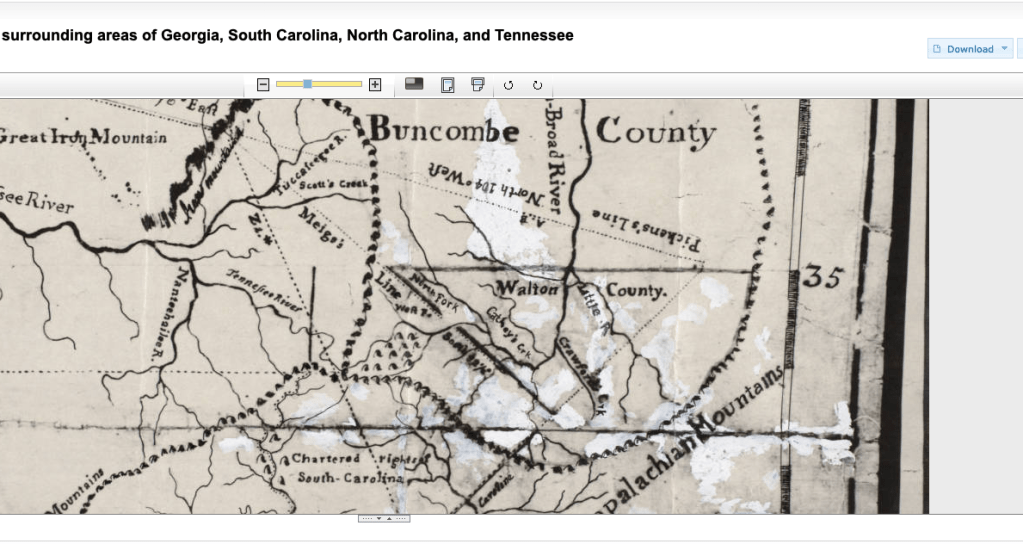
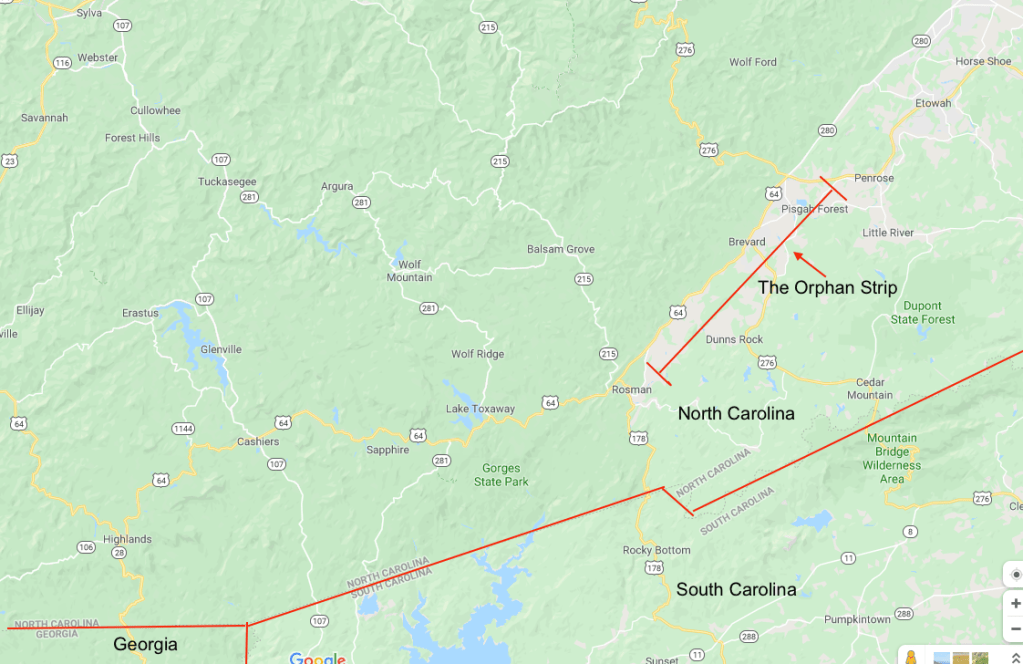
In 1812, what is now known as Transylvania County (formed from Henderson County) lies the historical and mostly forgotten Walton County of Georgia, a disputed strip of land that resulted in the WALTON WAR between Georgia, North and South Carolina. Basically, long story short, North Carolina took it back. Interestingly, the strip of land was known as the ORPHAN STRIP and it was considered to be a hideout for deserters and outlaws.
After that, the western portion of Old Tryon County expanded westward and formed counties like Hays, Macon, and Henderson, and Transylvania.
However, Rutherford and Lincoln County was the most complicated of county changes, for that in 1841, Cleveland County established itself smack dab in the middle between Rutherford and Lincoln County. Then, in 1844, Rutherford lost its north-western corner to McDowell County. In 1845, Lincoln County lost its southern half to Gaston County. Polk County formed in the northern-western corner of Rutherford County, just below Lake Lure, and in 1921, Buncombe county took over the north-western corner of Rutherford County from McDowell County. This kind of mess would make anyone’s brain spin! mapofus.com
Finding A Map That Works!
My biggest challenge by far in Vess Genealogy has been trying to locate a map with North Carolina’s rivers and creeks! You would think it would be easy.
Of course, Google-maps is somewhat helpful, but it doesn’t show a lot of the creeks, especially, those mentioned on early land grants where most earlier settlers called home. Probably, because many of the creeks have dried up and disappeared along with history.
I need a map of Old Tryon County, but many maps of Tryon County are difficult to come by and those that are available are not detailed at all. The next best thing is to look at individual county maps, but again they are not as detailed and it makes it extremely difficult to see the full spectrum of an entire community of early settlers, especially, a community that has been broken up by different counties. Very frustrating!
However, I FINALLY stumbled upon a very useful map [below]. A map of the “Broad River Basin, which can be found on The University of North Carolina at Chapel Hill library’s website: North Carolina Maps. I have NO IDEA how I found this website!!
Although this map is dated “1968,” it is exactly what I have been looking for! Not only does it show Rivers and Creeks, but also extends a little (just a little) outside the borders of Rutherford County, North Carolina. Basically, covering a good portion of Old Tryon County! Just want I needed!
Now We Are Getting Somewhere!
The first record of my earliest ancestor, Peter Vess, is an 1820 census record in Rutherford County, NC. After some research, I have determined that he was living on “Knobs Creek.”
Now that I finally have a decent map, I can use land records to determine nearby neighbors and begin to identify families who may have connections with him.
As of right now, I have complied a list of 19 land owners on and near Knobs Creek between 1775-1820. One by one, I am reviewing their land surveys.
Land survey’s (if they have one) tells me a lot! 1) Whose land they are joining (neighbor) 2) Whose properties their land touches (additional neighbors corners) 3) Witnesses (who are possibly close family or friends, some that don’t own land)
This is great, because I am finding more families who likely obtained land issued from Tryon County whose records were either lost, misplaced, or not available online yet.
However, I have just discovered that there are two Knob Creeks! I need to go back and review my research to determine which Knob Creek Peter Vess was likely living on in 1820. What is most exciting, is that the map I just recently found shows both Knob Creeks!
While reviewing land records, I have stumbled upon new interesting information which is beginning to form a somewhat crazy (or maybe not so crazy) new theory regarding my 4th great-grandfather’s origins! It will knock you off your feet!
Let’s start the New Year by reviewing what we know so far about the so-called three brothers from Ireland.
But first, a huge THANK YOU to everyone who has provided me information about their family history, lineage, and research!
The Three Brothers
According to our VESS family story, we descend from three brothers from Ireland: Jonathan, Peter, and Nathan (Nathaniel) Vess. However, records seem to tell a different story…
Records tell us that Jonathan, Peter, and Nathan Vess did in fact exist and that they all existed during the same time period (1790-1880); however, we have not yet found any records confirming their exact relationship to one another. Possibly, because they may have not been brothers at all, but perhaps a mix of relatives: 2 brothers and a father, cousins and 1 uncle, or 2 brothers and a grandfather.
The term brothers was often used to refer to any close male relationship: siblings, father, uncle, cousin, close family friend, or church member.
Interestingly, records tell us that Peter and Nathan were born in America (North and South Carolina). According to Nathan’s records, his parents were born in South Carolina. His family possibly lived in Glassy Mountain, Greenville, South Carolina with the Gosnell and Bellew families (who are related to Nathan’s wife, Clarinda Bellew). We have also discovered a new VESS line closely related to Peter, through a Willis Vess, whose records also state his parents were born in North Carolina.
If our VESS family does come from Ireland, research greatly suggests that our family arrived in America sometime prior to the Revolutionary War (1775-1783). And perhaps our family story is true, but we are looking at the wrong generation of men whose names were Jonathan, Peter, and Nathan; as it was once common practice that each generation be named after their forefathers.
VESS family in Patrick County, Virginia
We have recently discovered a “VESS” family in Patrick County, Virginia. As to-date, we have not been able to connect them to the prominent “VEST” family of Virginia; giving us hope that this pocket of Vess family is related to our VESS line.
The earliest records with the name “Vess” can be found in Virginia for a Samuel, Peter, Jonathan, and William Vess:
Jonathan Vess married Elizabeth Heron in 1792, Patrick County, VA. In 1820, Jonathan Vess and his wife Elizabeth migrated to the Republic of Texas [before Texas was a state]. He is written in the Texas history books, not only because he was one of the first families to travel with Stephen F. Austin (state capital is named after), but also the town of Morales, TX was established on his land and his daughter, Mary Lorena Vess, married Sam McCulloch, Jr., who was a Texas war hero and a man of color.
We have found Revolutionary War records under the “Vess” name, for a Samuel, Peter, and William Vess. Peter being distinguished as a Corporal.
In addition, Patrick County, VA tax records 1790-1799 lists Samuel and Peter “Vess.”
Lastly, there is a War of 1812 record for a “Peter Vest” in Surry County, North Carolina. Thus far, we have not been able to connect him to any of the VESS or VEST families in the area; including the nearby VEST family of Stokes County, NC. However, it should be noted that Patrick County, VA is located directly above Surry County, North Carolina. We also cannot confirm that this Peter “Vest” is the same person as our Peter Vess of Rutherford County, North Carolina.
The Discovery of Willis VESS – DNA Connection
I believe the most significant find of last year, for me at least, was discovering another Vess line closely related to Peter and Nathan: Willis Vess of Franklin County, Alabama.
Familytreedna.com
DNA has confirmed Peter, Nathan, and Willis Vess to be closely related; however, we do not know exactly how they are related to one another.
Y-Chromosome DNA on FamilytreeDNA.com has connected Willis and Peter’s line together and it is AncestryDNA.com, that confirms a “close” relationship between the two lines through shared DNA-relatives.
However, I suspect the relationship to be distant, for that I share more DNA-relatives with Nathan’s line than I do with those on Willis’s line. This may suggest that Nathan is likely more closely related to Peter than Willis; with Nathan and Peter as siblings/half-siblings and Willis a possible cousin. However, this could be inaccurate, largely depending on how many descendants on each line have tested through AncestryDNA.com.
Nonetheless, Willis lived during the same time period as Jonathan, Peter, and Nathan, so we can confidently suggest the connection is either through a parent or grandparent. Which brings me to Willis’s father, John Vess, who was supposedly born in North Carolina (1770) and married Margaret Vaughn.
The Vest Family of Virginia and North Carolina
Virginia
South Carolina
Many researchers suggest John Vess (father of Willis VESS) to be the son of William Tunwell Vest of Stokes County, North Carolina; however, I do not believe this to be true. I have researched the Vest family of Virginia and North Carolina extensively and have not found any records connecting the Vess and Vest families together.
William Tunwell Vess had 5 sons, Samuel, William, Charles, Isham, and John. According to my research (which could be wrong, of course), Samuel and William married “Cannifax” sisters, Charles married a “Doty,” Isham married a “Briggs” and a “Page,” and John married a “Ray.” I have not found any DNA relationships with any of their descendants.
If the Vest and Vess lines are related, they must be related distantly.
However, it may be worth looking into a James Harvey Vest, who is said to be born in Patrick County, VA in 1838. He married Rachel Jane Harper and Mary Calhoun. The reason I mention him, is because FamilytreeDNA has a VESS-VEST DNA Project Group, which states they have found a DNA connection with 2 members related to “VESS.”
We do know for a fact that some VESS lines do descend from the VEST family; however, none of those Vess lines seem to connect with our VESS line.
The VOSS Name
I am often told that our name used to be pronounced, “VOSS.”
Interestingly, there is a VOSS family in North Carolina with Greenbury Voss in Casewell County, North Carolina. He was supposedly born in Maryland and died in Pittsylvania, Virginia, having raised his family in Casewell, North Carolina. I truly have not done much research on the Voss family; however, records for this family include the surnames: VOSS, VASS, VESS, and VAUSE.
Greenbruy Vess may be worth looking further into for several reasons: 1) Records can be found with the Vess name. 2) His sons married into the Cook family that is related to the Cook family who attended Bills Creek Baptist Church (late 1800’s). 3) They are supposedly related to the Vause family in Georgia, who were in Georgia when Peter’s son, Alfred Vess, migrated there. 4) There is a Voss related to Greenbury Voss in Alabama (or Tennessee, if I remember correctly) near Willis’s Vess family! 5) Pittsylvania, Virginia is next to Patrick and Henry County, Virginia. 6) The Gonsell family (connected to Nathan) is from Maryland.
Conclusion
In short, there is no final conclusion as there is still more to explore and discover! The information we discovered and collected last year will certainly help us with our genealogy journey.
Any information you would like to share with us to help us with our research, please feel free to post in the comment sections or join our Facebook Group! I absolutely look forward to sharing new genealogy adventures with you!
Usually, New Years Eve is like any other day for me. No big celebrations. No big parties. I don’t even stay up anymore. But today is different! Today, I am so ready to say goodbye to 2020!!
Today, my family and I will stay up through midnight. I bought a banner, horns, hats, and two cans of black eyed peas for good luck! I even bought a bottle of sparkling wine! We are going to celebrate like it’s 1999! Remember how crazy that was!
I am also not a New Year’s Resolution type of person, but for the new year, I am totally motivated! Of course, I have come up a with a few personal resolutions, some that haven’t changed in the past 10 years, like eating healthier, exercise more, and save money. It’s the journey that counts! But in addition to all that stuff, I have come up a list of goals for Vess Genealogy!
10 Vess Genealogy Goals
1) Learn more about genetic genealogy and apply it in practice (when possible).
2) Research more often and post regularly. Get a routine going!
3) Post more history, timelines, pictures, and biographies.
4) Better organize my research. No more sticky notes and napkins.
5) Follow through with a researching game plan to avoid falling off task during research. Oh, a butterfly…
6) Become more actively involved in genealogy groups. Knowledge is power!
7) Encourage others to not give up on Vess Genealogy despite its challenges and road blocks. We’re just getting started and we need all the help we can get!
8) Write more posts about genealogy in general.
9) Publish a Vess Genealogy bookby the end of the year.
10) Have fun, don’t stress, and enjoy the adventure!
The Future of Vess Genealogy: Team Work
I’ve learned this year, that I can’t do Vess Genealogy alone.
I hope my website will not only become a place to preserve Vess family history, but also a place of collaboration, resources, and motivation for others doing their own research and that together, we can break through the challenging road-blocks of Vess Genealogy! 🙂
I hope everyone has a happy, healthy, and safe New Year!
I am in the process of reviewing, sorting, and organizing new information. A HUGE thanks to everyone who has sent me information about different Vess family lines and history!
This is what I have gathered so far (off the top of my head).
Peter, Nathan, and John certainly exist, but their relation to one another is still not known.
Peter and Nathan are closely related per Ancestry DNA, but there is no documentation (probates, census records, family bibles, or anything) confirming their exact relation to each other.
Peter was born in North Carolina.
Nathan was born in South Carolina.
Y-Chromosome DNA is connecting our family (Peter and Nathan) to a Willis Vess (Vest) of Alabama whose father is John Vess who is supposedly from North Carolina. The relation between Peter, Nathan, and Willis is not known.
John Vess maybe an older ancestor (maybe a father or uncle to Peter and Nathan) for that his descendants from his generation do not show up on Ancestry.com. Ancerstry.com can only take us back 6-7 generations. [For me, that barely picks up Peter’s generation]
There is a pocket of “Vess” family in Patrick County, Virginia that does not seem to have any kind of relation to the Virginia VEST family.
There is a John Vess from Patrick County, VA who migrated to Texas in 1820 with Elizabeth Heron.
There is a Peter and Samuel Vess of Patrick County, VA who seem to have connections with the Vaughn family. Willis Vess’s mother is supposedly Margaret Vaughn.
Y-Chromosome DNA suggests a strong family relation with the HAYES, JONES, and TRAVERS families.
I feel like we have research on two ends of the timeline and we are trying to figure out how they meet in the middle.
I am putting the Vess family of Virginia aside and continuing my research on close neighbors and family members related to Peter and Nathan. Interestingly, the search has led me back to Surry County, NC.
A few months ago, the names of soldiers listed above meant nothing to me; but today, they are very significant.
SKIDMORE, POINDEXTER, EAPERSON, SPRINKLE, BAGLEY, COOK, PHILIPS, and MORELAND have connections with William Tunwell VEST through his son Issac VEST. Several men on this list married William Tunwell VEST’S grand-daughters.
Issac VEST is shown living in Wilkes County. Many of the soldiers listed above do not live in Surry County, but are a mix of residents from surrounding counties (including Wilkes). Although I cannot find Peter VEST on census anywhere around or in Surry County, I did find a BELLEW family in Wilkes County. Nathan’s wife is Clarinda BELLEW and they eventually settled in Glassy Mountain, Greenville, South Carolina.
I have a feeling that our family were “boarders” and likely lived with other families as they migrated down to the Carolinas (I mean, that is one possible explanation for the lack of records on them).
For right now, I will be investigating Wilkes county and its surrounding counties a little further. Probate records, so far, have been the most valuable source of connecting families together. Unfortunately, probate records are not perfectly indexed and require thorough reading to find other families. Super fun!
Have information to share? Please feel free to share it with us in the comment section below. Thanks! 🙂











 Vess Genealogy