Investigating Willis Vess of Alabama: A Stumbling Start

This past weekend, I began to research Willis Vess of Alabama, just as extensively as Peter Vess of North Carolina; but I immediately stumbled upon a couple of genealogy road-blocks.

First of all, early Alabama records are weird.

Locating The Vess Family

In my opinion, the best way to research early families is to pin-point where they once lived and explore every part of their community, leaving no stone unturned.

Census records tell us that Willis Vess lived in Franklin County, Alabama (1830-1860) and then in Colbert County, Alabama (1870-1880). I suspect a county change rather than a physical move; which was later confirmed by maps.


Willis Vess was a farmer who had several properties and without the assistance of maps, I would have never been able to locate his properties; let alone find them in the correct county.

His land records state “Huntsville.”

Huntsville is in Madison county, a couple of counties east of Franklin and Colbert County.

This was confusing, especially, since the description of land does not reference rivers or creeks, but instead “Huntsvillecoordinates; which kind of implies the property is in Huntsville.

Did Willis Vess live in Franklin / Colbert County, but had farm land in Madison County?

Well, turns out that Huntsville was just a place that sold land. It says so, on an official land record available for Willis Vess; as if it was written in Old English by Dr. Suess!

Image below reads: “the North West quarter of the North East quarter of Section two in Township six of Range seven West, in the District of Lands Subject to Sale at Huntsville Alabama, certifying forty acres and four hundredths of an acre.”

Or so, that is what I think it reads. I had to read it several times, before finally comprehending what it really says!

But yeah, the “district of lands subject to sale at Huntsville Alabama,” means Willis Vess purchased his land (located in Franklin County) through the Huntsville land-office in Madison County. And note, the only reference to “Franklin County” on this record, is its greeting to “Willis Vess of Franklin County, Alabama.”

And we wonder why so many records get lost!

Fox Trap Creek


If there are no creeks or rivers to reference, where does one start to look?

Fortunately, I got a hint from FindAGrave.com (of all places).
If you look at the memorial for John Vess, father of Willis Vess, created by Anna Popejoy (long-time researcher), it states:

Mr John Vess was in Foxtrap by 1818. He built a Log Cabin in 1819/20. Cabin is still standing.”

I scoured the Internet. I didn’t know if Foxtrap was a community, creek, river, town, fort, plantation, mountain- or just some special spot only known to locals.

Surprisingly, I found Foxtrap on Google maps, by searching around Mountain Star (per sources on Ancestry.com). It is a creek that starts in Colbert County and extends downward into Franklin County, crossing Mountain Star Rd; which accurately reflects the county change seen in the census records for Willis Vess.


Interestingly, there are a few creeks named after early families surrounding Mountain Star; most notably: DODSON Branch and WHITLOCK Branch.

And for a good chuckle, there is also Rock Creek, Mud Creek, & Spring Creek (I assume these particular creeks had rocks, mud, and a spring) and then there is also Stinking Bear Creek which I would love to hear the story behind that one!

Then, after I spent an hour doing it the hard way….I found this on Alabama Genweb (Land Patent Mapping)! It has everyone!

This is a great resource to help me research neighbors (like I did with Peter and Nathan VESS), but I wish it had a date on it. I mean, some of these neighbors could have settled in as late as the 1880’s, which is not exactly helpful in tracing early settlers prior to 1820.

Where Did John Vess Come From

Of course this is multi-million dollar question! Where in the world did John Vess come from!

Besides an old cabin, there really isn’t any proof that John Vess ever existed – no census records or even a grave stone.

Franklin County, Alabama was established in February 1818 and according to Anna Popejoy (FindAGrave.com), this is about the time John Vess arrived to Foxtrap and according to Whitlock sources, it wasn’t until the 1820’s that the Whitlock family arrived from Georgia with the Thompson and Pennington families.

Looking at old maps between 1810-1820, it’s all Indian territory (including the western parts of Tennessee directly above Alabama).

One doesn’t just pack up their entire family and head 400+ miles for Indian territory alone; so there is a really good chance the Vess family didn’t travel alone. And, the safest route (I can think of) from North Carolina to Foxtrap Creek in Alabama would have probably been to go through territory already owned by the United States: South Carolina, Georgia, then Alabama.

So instead of traveling through Tennessee, John might have gone down through Rutherford County, North Carolina (Willis family) into Greenville County, South Carolina (Bellew and Gosnell family), through Georgia (Whitlock family), and straight across into Madison County (Huntsville) and finally settling in Foxtrap.

Of course, that is just a theory; one that might change if we find evidence of a connection with the VEST family who seem to have migrated into Tennessee, Kentucky, and Ohio.

The 1820 Census Blunder


If John Vess was living in Foxtrap since 1818, why is he not found on the 1820 census?
Was he so remote he got missed?

I guess I am not the only one who noticed, because apparently there is a very good chance he was missed!

According to an article posted on AL.com, there was a “mortifying miscount of the 1820 census,” where census workers supposedly quit during the census-taking process!

I don’t think any of the families in the Mountain Star area had been counted, because I do not recognize any of the names on the 1820 census for Franklin County, Alabama. There are no Whitlock, Dodson, Orr, Willis, Smith, Vandiver, or Isabell families listed on the census, but maybe they hadn’t arrived yet.

However, I still do not think the VESS family was alone.

Courthouse Fire

Not only do we have an incomplete census (when we really need one), but Franklin County also had a court house fire (in 1890). Who knows what records were lost (perhaps missing census tallies).

A Quick Recap Of What We Know

Despite such a stumbling start, we have learned quite a bit!

With DNA testing, we now know that Willis Vess of Alabama and Andrew Logan Vess of Rutherford County, North Carolina are closely related; but we have yet to figure out where they connect on the family tree.

Willis Vess appeared on record as early as 1837 (land record). He was a farmer who lived around Mountain Star along Foxtrap Creek in Colbert County, Alabama (once Franklin County). He married Talitha Whitlock, whose family arrived sometime during the 1820’s with the Thompson and Pennington families.

Records are scarce due to a census fail in 1820 and a courthouse fire in 1890.

Fortunately, we have a bunch of other resources to explore!

We have a map of neighbors, which means, we can explore records of close neighbors. We might also be able to locate the first settlers who may have traveled to Alabama with John Vess.

We also have the Mississippi Territory census record of 1816 to explore, which covered parts of Alabama before Alabama became a state! It really depends on when and where John Vess arrived in Alabama (via Tennessee or Georgia).

I really look forward to learning more about the VESS family of Alabama!


Analyzing Ancestral DNA: Vess Genealogy

Vess Genealogy has been stuck at a massive roadblock for generations.
In my opinion, I believe there was a name change.

Records do exist. Either we are missing the places they might be (due to county changes) or we are overlooking records, because the surname is indexed wrong due to illegible handwriting.

Our ancestors lived in an area during a time where county lines were constantly changing, which means there are probably some counties that we may never in a zillion years ever think to look for records.

The biggest reason I believe records do exist is because so many other early families of western North Carolina have a paper-trail.

Okay, it is not exactly the neatest of paper-trails for that when you get into early records (early 1800’s and back), surnames are really butchered (horribly misspelled) to the point that even if you squint and look at it sideways, it might (if you shout it from a distance with a little echo) sound phonetically similar to the surname that it was meant to be. So, in most cases, it is the content that usually confirms the persons identity more so than the indexed surname linked to the record.

My point is, if a good portion of early families in the same area have records, there is a good chance the Vess family also has records. Unfortunately, there are too many different surname variants and counties to explore. If we want to move forward a little faster, perhaps genetic genealogy can help us.


Check out this cool video below – A North Carolina dialect that evolved independently due to isolation since the 1600’s. If that is anywhere close to what our ancestors used to talk like, no wonder names were horribly misspelled.


What Is Genetic Genealogy

It is my understanding, as I am 100% new to this, that genetic genealogy is a new approach to tackling difficult ancestors who do not want to be found.

Instead of digging through dusty old archives for records to make family connections, we can now make family connections with the help of DNA relatives. Unfortunately, the name of our stubborn ancestors are not embedded into our DNA, but DNA-relatives can point us in the direction, like a compass, to locate genealogy records that might help us identify a common ancestor.

Essentially, the idea is to use both methods (DNA and records) together to quickly and more accurately make new connections on the family tree.

Y-Chromosome DNA Testing is GOLD

Y-Chromosome DNA testing is gold, but without a lot of participants, it can also be lead.

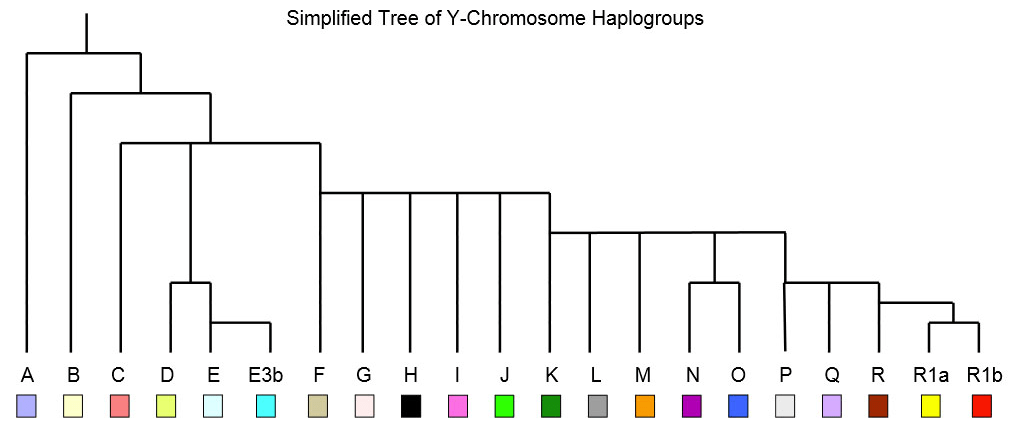
Every male descendant carries a gene called a Y-Chromosome. Geneticist’s extract the DNA from the Y-Chromosome, analyze it and assign it to a Y-Chromosome Haplogroup (A-R).

A haplogroup consists of a group of people who share very similar DNA with one another suggesting a single common ancestor. An extremely ancient common ancestor.


The more people who participate in Y-DNA testing, the more these Haplogroups can be broken down into smaller groups called a subclade. Subclades are subgroups of Haplogroups. Assignment is largely based on single nucleotide polymorphisms (SNP’s), which are specific mutations that correlate to specific paternal lines. Every time a mutation occurs over thousands of years, that genetic line branches off into a new subclade (or so that is my vague understanding of it).

As more DNA is collected and analyzed, the subclade may change; either resulting in grouping more people together into one subclade (moving from one existing subclade to another existing subclade) or having enough new information to create an entirely new subclade.

The VESS family is assigned to Haplogroup R. Haplogroup R has many different branches (subclades).

When members of the VESS family submitted their DNA, a new subclade was created where they were grouped together with the TRAVERS family (we are closely related), and then, when some members of the VESS family completed the BIG-Y Chromosome test (a more in-depth analysis), the VESS family was later assigned a new subclade although still grouped together with the TRAVERS family. This suggests a mutation.

It is interesting that our group has two different surnames and it kind of makes you wonder who came first: TRAVERS or VESS?

Did a male descendant of the TRAVERS family take the VESS surname, maybe from a step-parent, or was adopted by a VESS family or vice versa. There is also the possibility that our common ancestor could be from a time when surnames didn’t exist. OR we aren’t as closely related as we think and as more people begin to test, the VESS and TRAVERS family might drift apart into two different groups. The only thing I know for sure, is that it is a mystery we cannot solve today.

However, we did identify a new VESS line using Y-Chromosome testing: Willis Vess of Alabama.

The best thing about this DNA database, is that participants often note their oldest known ancestor which gives genealogists a specific location on a map to look for genealogy records. Although we know Andrew Logan Vess and Willis Vess are related, we have yet to determine how they are related to one another on the VESS family tree.

This is what I mean by Y-Chromosome DNA testing being gold but also lead. It has the potential to unravel many VESS mysteries, but without more participants, those mysteries will remain in the dark.

Male descendants carrying the VESS surname or one similar to it (VASS, VOSE, VOSS, VEST, VAUX, etc) are greatly encouraged to participate in Y-DNA testing through Familytreedna.com as there might be a genetic connection.

Autosomal DNA Testing

While Y-Chromosome DNA testing is a more direct route to identifying our paternal ancestors, autosomal DNA testing is more or less like taking the scenic route.

Y-Chromosome DNA tests provide you a much bigger genealogical timeline of just one paternal line that dates back to ancient times, whereas ancestral DNA tests are autosomal, which means they only go back 6-8 generations and is saturated by DNA-relatives on both sides of the family (paternal and maternal lines).

For me, my DNA-relatives related to the VESS line would mainly consist of descendants of Andrew Logan Vess (my third great-grandfather-6th gen). It would just barely (if at all) pick up DNA-relatives descending from Peter, Nathan, and Willis Vess or even their parents. It greatly depends on how many of their descendants have submitted an ancestral DNA test and just how far they descend down the Vess-family line.

With an 8-generation family tree, a DNA test by my mom, and access to DNA information provided by a close family member who is a generation older than me, I have been able to identify DNA-relatives specifically connected to the VESS family line via a lengthy tedious process of elimination.

Fortunately, my mom’s DNA test does half the work for me by identifying DNA-relatives on her side of the family. Then, I look at shared DNA relatives with the family member who is a generation older than me to further identify DNA-relatives that are most likely VESS-related. Because this family member is a generation older than me, their DNA test would detect more DNA-relatives, those who are too distant to be detected by my DNA test.

Any DNA-relative with less than a cM count of 8, do not make it onto the DNA-relatives list (it’s too distant), even though there is a relation on the family tree. In theory, it would probably be best to have our grandparents do an ancestral autosomal DNA test.
cM (centimorgan)= the amount of shared DNA.

My Search Method

I started by making a list of DNA-relatives who carry the VESS name. Next, I made a list of DNA-relatives with the VESS name who also have a public VESS family tree. Lastly, I made a list of DNA-relatives who do not carry the VESS name, but have a public family tree showing they descend (at one point) from a VESS family member.

For each DNA-relative listed, I noted their oldest known ancestor (some I had to research a bit) and I also had to check their shared-relatives list to make sure they didn’t share DNA with my mom (which was the most time consuming part).

My Discoveries

At a glance, autosomal ancestral DNA tests tell us nothing; except, we have a lot of cousins. But after an extensive process of elimination, then entering the information into a spreadsheet, and finally organizing the information from closest DNA-relatives to most distant DNA-relatives does it actually start to get interesting.

1) As expected, majority of our shared DNA-relatives are descendants of Andrew Logan Vess.

2) As you scroll down towards more distant DNA-relatives, we start to see connections with Willis Vess. Based on this, we can probably confidently say that Willis and Peter Vess are very closely related.

3) Willis Vess seems closer to us than Nathan Vess; which may suggest Nathan’s line has either ended or not many of his descendants have done an ancestral DNA test.

4) Also as expected, the autosomal DNA tests just barely detect DNA-relatives who are descendants of Josiah, Alfred, and Alexander Vess (brothers of Andrew Logan Vess).

5) Interestingly, there are a few DNA-relatives whose oldest VESS ancestor is one I do not recognize:

Susan Ann Elizabeth VESS (b. 1856 Rutherford Co. NC) and Columbus MCGINNIS
*connected to Ledbetter tree and father is noted as Thomas William VEST of Tennessee

Elizabeth Louise VESS (b. abt 1845 North Carolina) and William LANNING (marriage Henderson, NC)

Everline VESS and James STEWART (marriage Colbert, Alabama)

James Marvin VESS (b. 1853 South Carolina) and Sallie Octavia SPRUELL

**One of the Elizabeth’s might be the daughter of Peter Vess

6) But even more interesting are DNA-relatives whose oldest VESS ancestor is Addison Vess/Vest.

You would think this is a solid connection to the VEST family of Virginia, but if you look at the family trees for Addison VESS/VEST, they are not well documented and there is no consistency with Addison’s children or parents, which is a RED FLAG in genealogy.

Final Conclusions

I am not an expert, so please keep in mind my search method could be flawed and thus the information within this post could be highly inaccurate.

We still do not have enough information to find new ancestors, but we do have enough genetic evidence to start digging deeper into the life of Willis Vess without wondering whether or not we are wasting our time. Yes, Y-Chromosome testing confirmed he is related to Peter Vess, but autosomal DNA testing suggests the relation is much closer than we think.

Also, we might want to start to investigate Addison VESS/VEST for that his name appeared quite consistently in the chart below. The reason he showed up, is because his descendants some how took on the VESS name rather than keeping the VEST name like other VEST families; in which I think is intriguing. Why did this particular VEST line evolve into a VESS line?

Well, I guess we better start digging!! 🙂

Similar Surname, Similar Family Story: Vess Genealogy

Research Journal – March 2, 2021

Exploring Families With Similar Surnames

Prior to 1820, the “Vess” name seems scarce.
This is either because the Vess family just recently arrived to America or that there was a name change. Today’s research strongly suggests a name change.

When a surname is misspelled, we often tend to overlook important records. My genealogy game plan to bring these records to light is to research the neighbors of Peter, Nathan, and Willis Vess and investigate any nearby families with a similar surname. So far, I have a couple of excellent contenders with the VEST, VOSS, BEST, and BASS families. Unfortunately, I have yet to find any documents to confirm a direct connection with any of them.

With a handful of different families with similar surnames already piled high on my research plate, I had no intention on investigating anymore families; however, I would be foolish to disregard a family whose family story seems quite similar to our own family story…

The VASS Family: Sounds Oddly Familiar

I have spent years reaching out to different families with similar surnames in hopes one would have a similar family story to ours, but nothing ever came close until now…

I stumbled upon the VASS family with a document that wasn’t even about the VASS family itself, but more so about a man named Pendleton in Virginia whose daughter married a Vass. I can’t even tell you why I was looking at Pendleton to begin with, which happens a lot.

In genealogy, one document often leads to another document, then to another and another to the point you’re not exactly sure who it is that you were looking for in the first place! Honestly, I am pretty sure this all started with looking at map.

As I was saying, I stumbled upon a document that led me to more documents about the VASS family in Virginia. After reviewing my notes, I was shocked by how similar their family story is to ours…

1) Instead of Ireland, their “long time” family story has always been about “3 brothers from Germany.”
2) Their name used to be pronounced as “Voss” (just like us).

3) Some say they are German in origin and others say Scotland. (just like us, but instead of Scotland, it is Ireland).

There are a couple of documents pertaining to the VASS family, some of which strongly suggest they are Scottish, as part of the ROSS-Clan, with surname variants of Vaux, Vaus, and Wass. The Wass version is what they believe mistakes them for German. One source states the original name was DE-VALLIBUS; in my opinion, sounds French.

The VASS family was supposedly a prominent family in Virginia via John Vass and Rachel Pendleton. Their descendants eventually went down into North Carolina with the variant surname VOSS. They settled in parts of Casewell and Pasquotank Counties. [Note: There is Greenbury Voss/Vess in Casewell County]

Furthermore, there is a Vincent Vass (b. 1790) who married Mary Cosner living in Stokes County, North Carolina during the early 1800’s. This is interesting, because it means that William Tunwell VEST was not the only family in the area at the time with a similar surname to “VESS.” Also, we have a Peter Vest on a War of 1812 Surry County, NC record that we have not been able to connect to either the VESS or VEST family.

The VASS family is supposedly connected to the North Carolina VOSS family, which got me thinking: Is Frederick “Bass” of Anson County, NC, neighbors with the Bellew family, related to this VASS/VOSS mix?

The document linking the VASS/VOSS family (John Vass & Rachel Pendleton) to Vincent Vass cuts off and does not mention how they are related; unfortunately, I have not been able to find the original publication to read onto the next page.

I have just barely scratched the surface of the VASS family. As I mentioned before, this search initially began with looking at maps, in which I think has something to do with the names Whitlock, Vaughn, & Thompson scribbled on a piece of paper next to the name Pendleton. Of course, I didn’t jot down their connection!

Glasgow, Scotland

All this mention of Scotland, reminded me of Glasgow, Scotland.
See, my DNA results show ancestors having once living in Glasgow, Scotland. This intrigues me, because in the 1820-1830’s, we see records for a “Vess” family arriving to America from Glasgow. I do not know if there is a connection yet, but it is interesting nonetheless.


The VOSE Family: Lancashire, England

As if the pile of families with similar surnames wasn’t big enough, the VASS family led me to another:

There is one source that made a brief connection between the VASS and VOSE family, in which is not well understood. In my opinion, it seems as if they were connected together, because both families share the surname variant of VAUX. However, before tossing this family aside into the “maybe” pile, one particular thing caught my eye: The VOSE family is from Lancashire, England.


This brings me to the TRAVERS family of Lancashire, England. It is my understanding that Y-DNA data currently suggests that the VESS and TRAVERS families are related and it is believed that the two families split “prior to mid-1650.”

Interestingly, I came across a 1784 marriage record for a Mary TRAVERS and an Edward VOCE (VOSE) in Lancashire, England, but no family tree to determine further connections (if any).

The VOSE family is originally from Normandy. Interestingly, (in my opinion) the name DE-VALLIBUS that is supposedly associated with the VASS family, seems more fitting for this VOSE family.

In the early 1600’s, Robert and Sarah Vose migrated to America. Further research shows that the VOSE family prominently living in Massachusetts with no mention of any family migrating South. So with that, I tucked the VOSE family away with the WEST family- ruling them out completely.

Henry Vose of Virginia

Interestingly, buried within a plethora of documentation about the VOSE family in Massachusetts, there is this tiny bit that reads:
“Henry Vose, who arrived in Virginia in 1653.” houseofnames.com

Now, THAT is much closer to the Carolina’s!
I decided to type his info into Ancestry.com where I came across this piece of genealogy gold [right]!

He arrived in North Hampton, Virginia in 1653, sponsored by Anti. Hoskins. And guess what other name is listed with his: William Willis!

This is interesting, because we think the Willis Vess family in Alabama (from North Carolina) might have a connection with a Willis family.

Of course, this doesn’t confirm anything.

No Solid Connections Yet

Although I am disappointed that no new connections have been made, this new information is encouraging.

This new information isn’t pointing me into a new direction (which is exciting), but more so back to where I’ve already been; meaning, there is a good chance I was on the right track, but missed something! I just have to figure out what.

So far, I have recognized that research seems to be on opposite ends of our family history timeline and we are just needing to fill in a 140+/- year gap. We can trace our lineage to Peter, Nathan, and Willis and we know (via DNA) that at some point they were connected to the Travers family in England. So, roughly between 1650 – 1791 is missing.


Well, this should be fun!